

Cultivated meat is only low-carbon when the electricity behind it is low-carbon. If production runs on a fossil-heavy grid, emissions can match or even go above beef in some cases. If it runs on wind and solar, studies suggest emissions can be 78% to 96% lower than conventional meat.
Here’s the short version:
- Electricity is the main factor in cultivated meat’s climate impact.
- Location matters because grid power differs from place to place.
- Process type matters too: pharmaceutical-grade production has a much higher footprint than food-grade methods.
- Land use stays low either way, with estimates of 99% less land than conventional meat.
- Water savings are less certain on dirty grids because coal and gas plants use water for cooling.
- For UK readers, the key questions are simple: What powers the site? How much of that power is renewable? Is the claim backed by a peer-reviewed lifecycle assessment?
| Scenario | Carbon result | Land use | Water result |
|---|---|---|---|
| Cultivated meat on a fossil-heavy grid | Can be as high as, or higher than, beef | About 99% lower | Mixed |
| Cultivated meat on a low-carbon grid | About 78%–96% lower than conventional meat | About 99% lower | Often lower than beef |
| Conventional beef | High baseline | High baseline | High baseline |
If I cut this down to one line, it’s this: cultivated meat’s climate case depends less on the meat itself and more on the power source behind the factory.
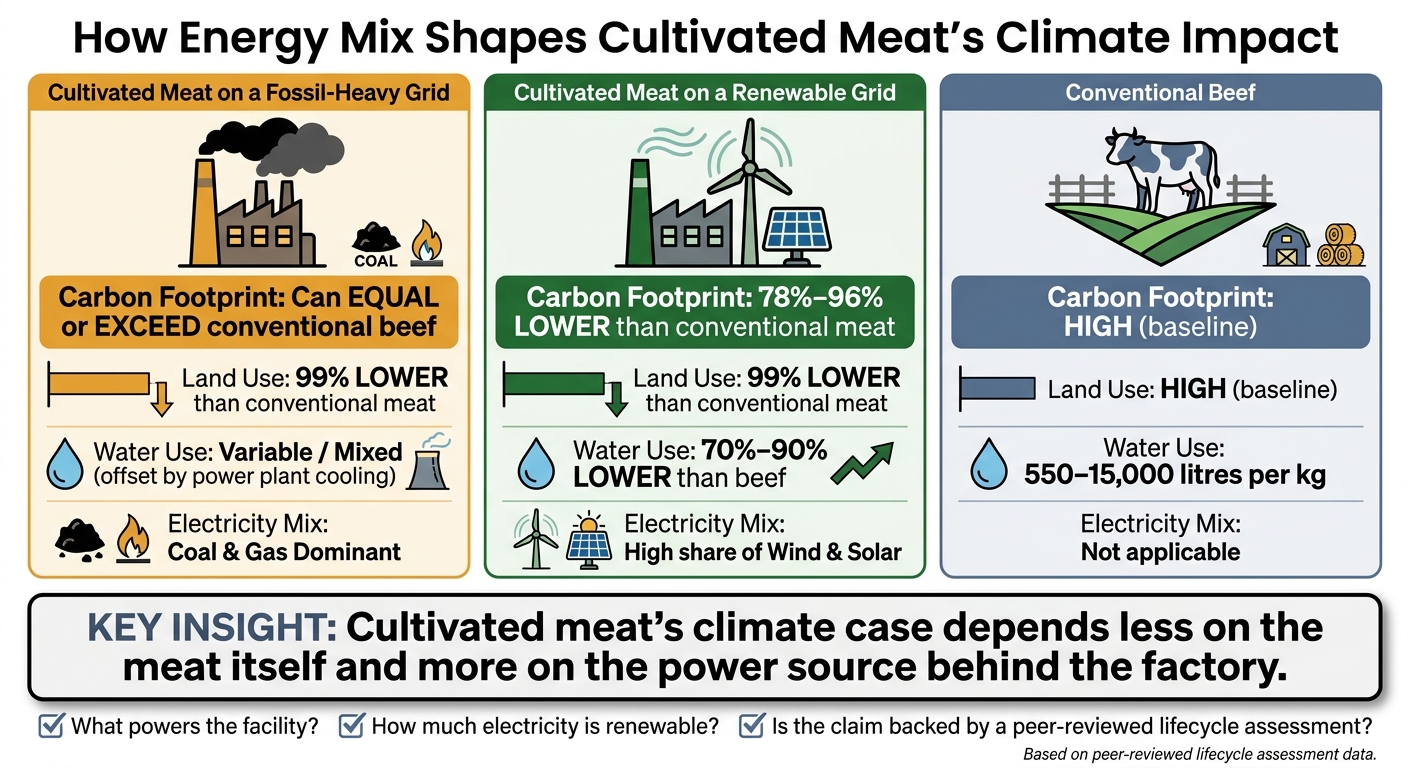
Cultivated Meat Carbon Impact: Fossil Grid vs Renewable Grid vs Conventional Beef
Dr. Elliot Swartz: The environmental impacts of cultivated meat production
sbb-itb-c323ed3
The problem: Cultivated Meat uses a lot of electricity
Cultivated Meat production uses a lot of power. Different bioreactor designs need electricity around the clock for temperature control, sterilisation and nutrient circulation. So the issue isn’t just how much electricity is used. It’s also the carbon intensity of the electricity behind it.
That’s why lifecycle assessments often come down to power use.
Why power demand matters more than most people expect
A life-cycle assessment (LCA) looks at a product’s total climate impact from inputs to the final product. In these assessments, electricity often ends up as the main variable. Cells need tightly controlled conditions to grow, and that means steady power throughout the process.
In plain terms, if the electricity is dirty, the footprint climbs. If the electricity is cleaner, the footprint can fall.
How this differs from beef, pork and chicken
With conventional meat, the main climate drivers are methane from animals, nitrous oxide from fertilisers, and land-use change. With Cultivated Meat, the main driver is the carbon intensity of the electricity used to run the facility.
The difference is easiest to see side by side.
| Protein Source | Primary Emission Drivers | Sensitivity to Electricity Grid |
|---|---|---|
| Conventional meat (beef, pork and chicken) | Methane, nitrous oxide, feed production and land-use changes | Low |
| Cultivated Meat | Bioreactor power, cooling and sterilisation | High |
Conventional meat is shaped mainly by farm emissions and land use. Cultivated Meat is shaped mainly by electricity. That means the grid mix can shift its climate impact over time. A fossil-heavy grid can wipe out much of the climate upside, while cleaner power can bring it back.
How grid mix can push results from better to worse
The same Cultivated Meat product can end up with a very different carbon footprint based on one thing: where its electricity comes from. That power mix can swing the climate result hard. In some cases, it can move the product from lower-impact to higher-impact. So in this part of the picture, electricity is the main variable.
Fossil-heavy grids can cancel out much of the climate benefit
If production runs on coal- and gas-heavy grids, the electricity load can wipe out much of the climate upside. Some lifecycle analyses show it can even exceed conventional beef on fossil-heavy grids [1]. That's the big issue behind any sustainability claim.
There’s also a water trade-off. Coal and gas plants use water for cooling, which can eat into expected water savings [1]. So while the land-use edge stays strong - Cultivated Meat uses an estimated 99% less land than conventional production [1] - the carbon and water story gets much messier on a dirty grid.
Renewable power can cut impacts by a large margin
Swap that grid for wind or solar, and the numbers change fast. With a largely renewable mix, emissions can fall by 78% to 96% versus conventional European meat [1]. That’s a huge gap.
Even then, process efficiency still counts, especially the carbon impact of different production inputs [1]. But as grids decarbonise, the footprint of the very same facility can drop without any change to the product itself.
Comparison table: fossil-heavy grid vs renewable grid vs conventional meat
| Scenario | Carbon Footprint | Land Use | Water Use (per kg) | Electricity Mix |
|---|---|---|---|---|
| Cultivated Meat - fossil-heavy grid | Can exceed conventional beef [1] | 99% lower than conventional [1] | Variable; can be partly offset by power plant cooling [1] | Coal and gas dominant |
| Cultivated Meat - largely renewable grid | 78%–96% lower than conventional [1] | 99% lower than conventional [1] | 70%–90% lower than beef [1] | High share of wind and solar |
| Conventional beef | High (baseline) | High (baseline) | 550–15,000 litres [1] | Not applicable |
The table lays it out pretty clearly: Cultivated Meat keeps its land-use edge no matter what grid it uses, but its carbon and water results are tied closely to the power behind production. Put simply, cleaner electricity and the right site choice make all the difference. You can model these variables using a sustainability calculator to compare footprints.
The solution: cleaner grids, better siting and smarter power choices
These impacts aren't fixed. The main levers are pretty straightforward: cleaner electricity, better siting, and production methods that use less energy.
Why the UK grid outlook matters for future assessments
In the UK, future assessments will depend a lot on how fast the grid cuts its carbon intensity.
That means facility choice and power sourcing are the fastest ways to lower impact right now.
What producers and policymakers can do
Producers have a few practical options. One of the most direct is to place facilities in regions with high renewable energy penetration [1]. Buying electricity from renewable sources also cuts reliance on a high-carbon grid. And moving from pharmaceutical-grade to food-grade media and processes can reduce energy use [1].
Process design matters as well. Larger bioreactors and continuous harvesting can lower energy use per kg of meat produced [1].
For policymakers, support for the wider shift of the electricity system towards renewables matters too. That's because Cultivated Meat's climate benefit depends on the local power mix [1].
Comparison table: three paths to lower electricity impact
These routes work best when used together.
| Pathway | Climate impact | Feasibility in the UK | Main trade-offs |
|---|---|---|---|
| Facility-level renewable sourcing | Lowers electricity-related emissions directly | Possible now where renewable power can be secured | Depends on access to low-carbon electricity |
| National grid decarbonisation | Improves impacts across the sector over time | Depends on national energy policy | Benefits arrive gradually |
| Combined approach | Strongest overall outcome | Achievable as the sector scales | Needs coordination across producers and policymakers |
When production is optimised, Cultivated Meat can achieve 78% to 96% lower greenhouse gas emissions compared with conventional European meat [1].
What UK consumers should look for when judging Cultivated Meat impact
Grid mix can change the picture quite a bit. So when you read any climate claim about Cultivated Meat, look at two things first: the facility’s power source and the way the product is made.
Cultivated Meat is not automatically low-carbon. Its impact depends on electricity use and process design.
Key points for reading future sustainability claims
The biggest factor is the electricity source. Bioreactors run all the time to handle temperature control, sterilisation and nutrient circulation. If a facility uses renewable electricity, emissions can fall sharply. If it relies on a fossil-heavy grid, that upside can disappear[1]. In plain terms, the very same site can look better a few years from now if the grid gets cleaner.
Process grade also matters. Pharmaceutical-grade production has a higher carbon impact than food-grade processes[1].
One of the clearest signs of climate impact is simple: how open the company is about its energy mix. If there’s no detail on energy, there’s no strong basis for a climate claim.
When these products reach UK shelves, ask:
- What powers the facility?
- How much of that electricity is renewable?
- Is the claim backed by a peer-reviewed lifecycle assessment?
A percentage reduction on its own tells you very little if you don’t know the grid mix and production method behind it.
Those checks are the fastest way to read future sustainability claims with caution.
FAQs
Why does electricity matter so much for Cultivated Meat?
Electricity matters because Cultivated Meat is made in bioreactors that need a constant power supply. Those systems have to hold tight control over temperature, oxygen, sterility and sterilisation. If the power slips, the process can too.
A big share of Cultivated Meat’s carbon footprint comes from electricity use. So its climate impact depends a lot on where that power comes from. Production run on renewables can cut emissions by a large margin. But if the grid leans heavily on fossil fuels, a lot of that climate upside can disappear.
There’s also a time factor here. As electricity grids get cleaner, Cultivated Meat is expected to have a lower footprint than it does today.
Can Cultivated Meat be high-carbon on a dirty grid?
Yes. Cultivated meat can be high-carbon on a dirty grid because making it takes a lot of energy. A big share of its greenhouse gas footprint comes from the electricity used to run the system and keep the process clean.
On grids that still lean heavily on fossil fuels, emissions can end up close to - or in some cases higher than - those from conventional beef.
Switch to low-carbon or renewable electricity, though, and the picture changes fast. Emissions can drop by about 80–92% compared with beef.
How can I check if a climate claim is credible?
Look for cradle-to-gate life cycle assessments (LCAs) that clearly define the system boundary and report indicators such as kg CO₂e, litres, and m².
Then check the assumptions behind the electricity grid. Results can shift a lot depending on whether the power mix leans on renewables or fossil fuels. Good reports also spell out their methods, draw on more than one data source, and include sensitivity analysis.


