

Entrepreneurs in cultivated meat rely on research institutions to access expertise, advanced equipment, and shared facilities, significantly cutting costs and development time. These partnerships help startups overcome technical challenges like creating serum-free growth media and scaling production. Universities also boost credibility, attract investors, and provide skilled talent through training programmes. Examples include UC Davis' iCAMP and collaborations like Aleph Farms with the University of Bath, which achieved faster cell growth and reduced costs. Such alliances are shaping a more efficient food system by reducing greenhouse gas emissions, land use, and resource consumption compared to conventional farming.
Why Entrepreneurs Partner with Research Institutions
Access to Advanced Research and Expertise
Research universities play a key role in supporting cultivated meat startups by offering expertise in areas like stem cell biology, muscle physiology, and tissue engineering - all essential for producing cultivated meat. Collaborating with these institutions allows entrepreneurs to tap into specialised knowledge without needing to build costly in-house teams. Take UC Davis, for example: it’s a leader in these disciplines and provides startups with access to Bay Area investors, business know-how, and resources for advancing food technology. In January 2024, UC Davis launched the Integrative Centre for Alternative Meats and Proteins (iCAMP), a hub dedicated to education and research in alternative proteins [1]. These partnerships also help startups save money by using shared facilities and equipment.
Shared Resources Reduce Costs
Setting up a biotech facility is expensive and often out of reach for early-stage startups. Partnering with universities eases this burden by granting access to shared laboratories, bioreactors, and skilled research staff. Beyond infrastructure, research institutions tackle common industry challenges - such as stabilising cell lines and creating affordable growth media - helping startups reduce both risks and costs. These efficiencies not only make operations more affordable but also instil confidence in investors.
Building Credibility and Attracting Investors
Teaming up with well-known research institutions boosts credibility and draws investor attention. For instance, the National Science Foundation (NSF) awarded $3.55 million to UC Davis researchers to advance the science behind sustainable cultivated meat production. This non-dilutive funding validates the technical feasibility of the industry. Additionally, the UC Davis Growing Convergence Research (GCR) Advisory Board, established around 2020, connects startups with industry heavyweights like Dr Bob Kiss (UPSIDE Foods), Noreen Hobayan (BlueNalu), and Dr Timothy Olsen (Merck KGaA). In September 2021, UPSIDE Foods and Merck KGaA further strengthened ties by sponsoring a cultivated meat short course through the UC Davis Biotechnology Programme. This partnership not only aligns their brands with cutting-edge research but also supports workforce training [1]. All these elements accelerate product development and solidify the scientific groundwork for the cultivated meat industry.
sbb-itb-c323ed3
How Partnerships Work in Cultivated Meat
Working Together on Cultivated Meat Development
Research institutions play a crucial role in tackling the technical hurdles of cultivated meat production. They focus on advancing cell culture methods, creating serum-free growth media, and developing 3D scaffolding - all critical for producing structured cultivated meat. Universities also provide startups with access to specialised facilities, including bioreactors, test kitchens, and cell banks stocked with cultured cells.
A notable example of collaboration took place in April 2022 when Rutgers University researchers Yong Mao and Joseph Freeman teamed up with the biotech company Atelier Meats. This partnership combined Mao's expertise in extracellular matrices with Freeman's knowledge of muscle regeneration to create proprietary technology for structured cultivated meat. Rutgers Innovation Ventures facilitated the collaboration, managing research agreements and intellectual property rights [2]. Similarly, between 2020 and 2024, the UC Davis Cultivated Meat Consortium (CMC) used a £2.9 million NSF Growing Convergence Research grant to refine cell lines and media. They worked closely with industry leaders like UPSIDE Foods and Merck KGaA, laying the groundwork for effective management of intellectual property [4].
Managing Intellectual Property and Licensing Agreements
Securing intellectual property (IP) early is essential to avoid conflicts that can stall progress. University technology transfer offices, such as Rutgers Innovation Ventures and UC Davis InnovationAccess, assist startups in obtaining commercial rights while generating royalty revenue for the institutions. These agreements often clarify the ownership of key resources like cell lines, which may originate from specific animal breeds.
"Innovation Ventures was able to make this agreement work with terms where everyone could get something that they needed so that we could start this as soon as possible." - Joseph Freeman, Professor and Director of the Musculoskeletal Regeneration Laboratory, Rutgers University [2]
A significant development occurred on 17 October 2024, when UPSIDE Foods was granted patent US11771112B2, originally owned by the now-defunct SciFi Foods. This patent covers recipes for "meat substitutes using animal cells and exogenous heme-containing protein on plant-based meat dough matrices" [5]. In another key move, the Good Food Institute acquired several bovine cell lines and serum-free growth media from SciFi Foods' creditors in August 2024. These assets were later transferred to Tufts University's Centre for Cellular Agriculture in September 2024, making them publicly available [5]. Beyond IP management, universities contribute to growth by fostering innovation ecosystems.
Using University Ecosystems for Growth
Universities provide more than just technical and legal support - they create vibrant innovation ecosystems that help accelerate progress. Innovation hubs and accelerators at universities connect entrepreneurs with mentors, investors, and diverse teams. For instance, in January 2026, Tufts University launched a £1.6 million state-funded innovation hub for cultivated foods, led by David Kaplan of the Tufts University Centre for Cellular Agriculture. This hub offers lab equipment, a cell bank, and has already supported five biotech startups, including Deco Labs, which developed a plant-based nutrient for cell cultivation [3].
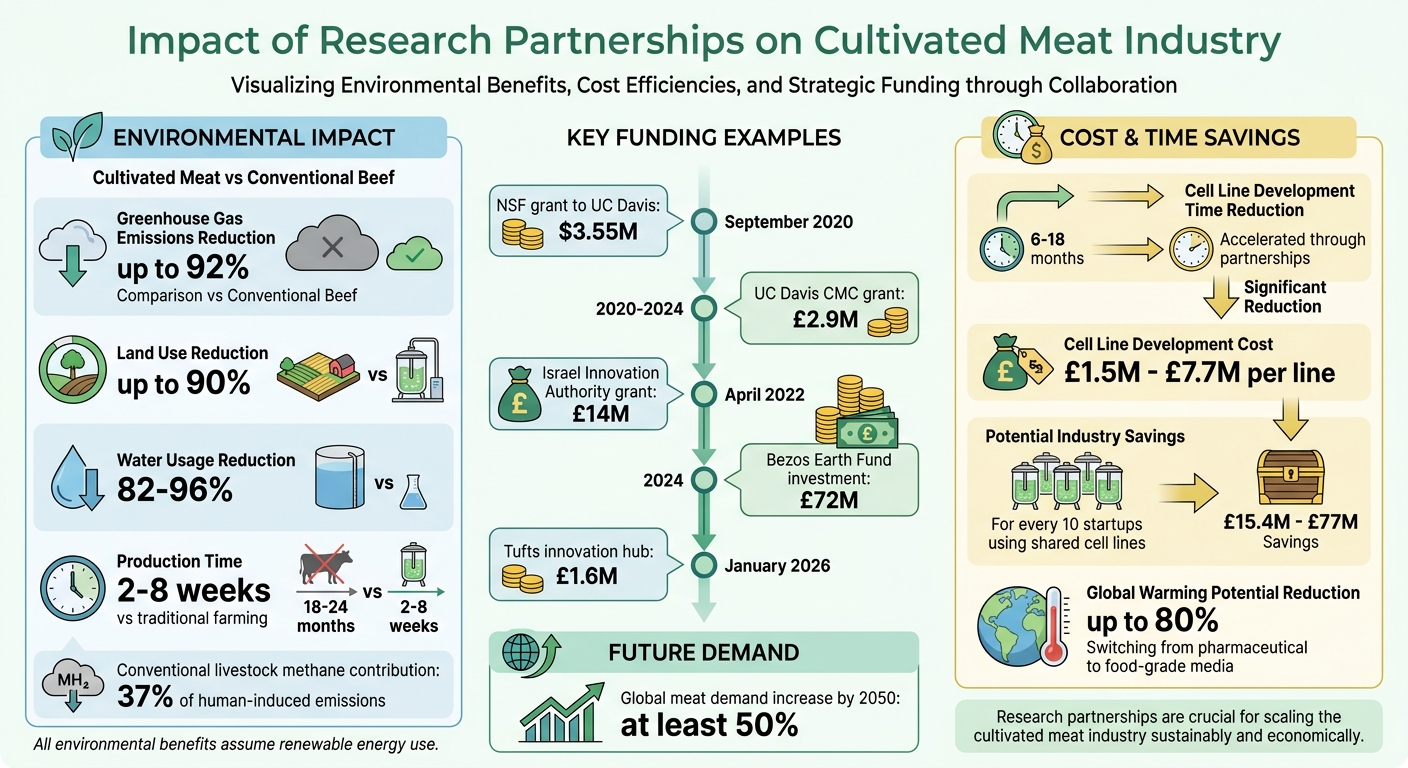
Developing a commercial cell line is no small feat, costing anywhere from £1.5 million to £7.7 million [6]. However, shared access to cell lines through university partnerships could save the industry between £15.4 million and £77 million for every 10 startups launched [6]. Universities also play a role in workforce development. For example, the UC Davis Biotechnology Programme offers short courses in cultivated meat, helping to build a skilled talent pool while connecting startups with industry professionals [4].
The Cell Ag Consortium at Tufts University
Benefits for the Cultivated Meat Industry
Environmental and Economic Benefits of Cultivated Meat Partnerships
Collaborations between entrepreneurs and research institutions are proving to be a game-changer for the cultivated meat sector, offering clear advantages in terms of progress, trust, and sustainability.
Faster Product Development and Innovation
Partnerships with research institutions can significantly reduce the time it takes to develop new cell lines, cutting the process from 6–18 months [9]. By working with universities, startups gain access to well-characterised cell lines, allowing them to speed up product development. These collaborations are also driving advancements in second-generation cultivated meat production systems. For instance, SuperMeat's innovative bioreactor, unveiled in February 2025, enhances the formation of muscle fibres and fat cells, making it ideal for whole-cut meat products. Meanwhile, Mosa Meat's 2023 partnership with Nutreco improved the cell feed supply chain, reducing basal media costs and moving the industry closer to matching the cost of conventional meat [11][13]. These technological leaps are not just about faster production - they also strengthen consumer confidence in these products.
Building Consumer Trust Through Scientific Research
Research institutions play a crucial role in validating the safety and quality of cultivated meat. For example, Tufts University's Centre for Cellular Agriculture is actively working to establish public standards for safety and nutrition [7]. Scientific studies have shown that cultivated meat is nutritionally on par with conventional meat and is produced in sterile environments, significantly lowering the risk of foodborne illnesses [2][8].
"Anything made in a lab is probably going to be the cleanest, safest stuff you're ever going to eat." - Joseph Freeman, Professor and Director of the Musculoskeletal Regeneration Laboratory, Rutgers University [2]
As of 2025, all approved cultivated meat products are produced without the use of antibiotics [8]. This level of scientific transparency not only counters misinformation but also helps distinguish cultivated meat from heavily processed foods like sweets and fizzy drinks [2]. Rigorous data further supports regulatory approvals, such as the FDA's "no questions" letters, which assure consumers that these products meet stringent safety requirements. For those looking to learn more about the science behind cultivated meat and its benefits, platforms like Cultivated Meat Shop offer reliable information.
Supporting a More Efficient Food System
The environmental benefits of cultivated meat are hard to ignore, especially when compared to conventional livestock farming, which contributes 37% of all human-induced methane emissions [12]. Life-cycle assessments show that, when produced with renewable energy, cultivated meat can cut greenhouse gas emissions by up to 92% and reduce land use by up to 90% compared to traditional beef. Water usage can also drop by 82–96%, and production times are significantly shorter - just 2–8 weeks [8][9][12].
Academic research is paving the way for a shift to food-grade production methods. Currently, pharmaceutical-grade growth media can have a global warming potential 4 to 25 times higher than retail beef. However, switching to food-grade media could cut this impact by up to 80% [14]. In April 2022, the Israel Innovation Authority provided a grant of around £14 million to a consortium led by Tnuva, which includes 14 cultivated meat companies and 10 academic labs, to develop a unified pilot production line [12]. Similarly, in 2024, the Bezos Earth Fund invested approximately £72 million to establish the Bezos Centres for Sustainable Protein at institutions like Imperial College London, North Carolina State University, and the National University of Singapore [10]. With global meat demand expected to rise by at least 50% by 2050, these partnerships are essential for creating a more sustainable and efficient food system [10].
Conclusion
Collaborations between entrepreneurs and research institutions play a crucial role in addressing the hurdles faced in cultivated meat development. These partnerships yield practical results, such as creating stable cell lines, refining serum-free culture methods, and offering essential economic insights that drive commercial success.
In September 2020, the National Science Foundation (NSF) awarded $3.55 million to a UC Davis team for groundbreaking research in cultivated meat production. This initiative bridges academic expertise with industry demands, highlighting the power of such alliances [1]. Additionally, programmes like UC Davis' iCAMP are instrumental in building a skilled workforce, training professionals who are pivotal for scaling production [1].
From achieving cost reductions to speeding up innovation, these collaborations demonstrate significant benefits. As highlighted earlier, the future of cultivated meat hinges on these strong partnerships. Sustained cooperation between academia and industry is vital for creating an economically viable and sustainable food system. To explore more about these partnerships, visit Cultivated Meat Shop.


