

Cultivated meat offers a promising alternative to conventional meat, addressing ethical and safety concerns. However, its high production costs keep it out of reach for most consumers. Here’s why it’s so expensive and what’s being done to change that:
- Growth Media Costs: The nutrient-rich liquid for cell growth is the biggest expense, with components like recombinant proteins and growth factors driving up prices.
- Bioreactor Limitations: Existing bioreactors, borrowed from the pharmaceutical industry, are costly and unsuitable for large-scale food production.
- Cell Line Challenges: Sourcing and maintaining reliable cell lines that grow efficiently at scale is complex and expensive.
- Scaffolding Materials: Creating edible, structured meat cuts requires costly materials and advanced techniques.
- Regulatory Hurdles: Lengthy approval processes and infrastructure shortages delay market entry and increase costs.
- Consumer Expectations: Matching the taste, texture, and price of conventional meat remains a significant obstacle.
Despite these challenges, production costs have dropped significantly over the last decade, and ongoing efforts focus on reducing input costs, improving bioreactor designs, and streamlining regulatory processes. The goal? Making cultivated meat affordable and widely available while meeting consumer demands for quality and taste.
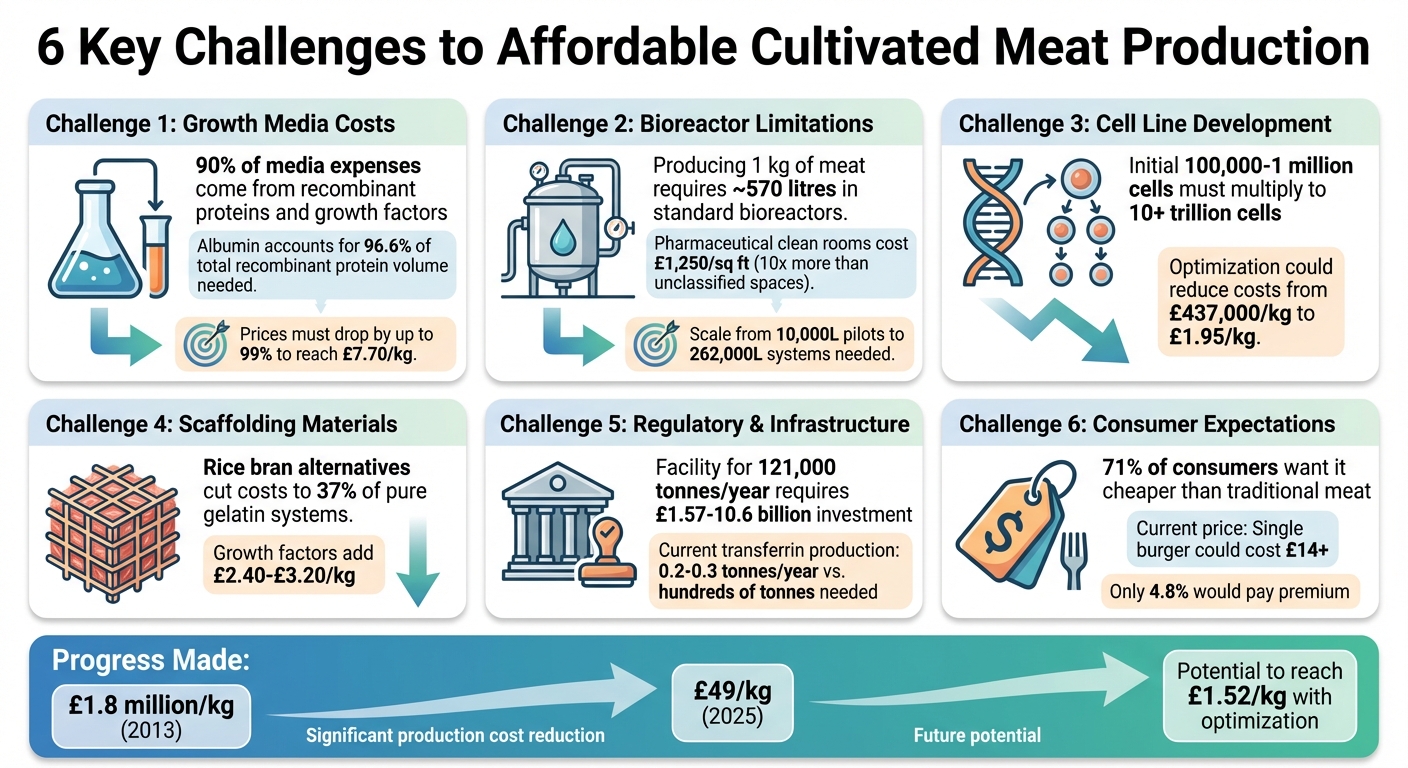
6 Key Challenges to Affordable Cultivated Meat Production
Cost drivers of cultivated meat production
sbb-itb-c323ed3
Challenge 1: Expensive Growth Media
Growth media, the nutrient-rich liquid essential for cell growth and development into meat, is the biggest cost factor in producing cultivated meat. It consists of two main ingredient categories: the basal medium, which includes relatively low-cost components like glucose, salts, and vitamins, and recombinant proteins and growth factors, which significantly drive up costs. These additional factors - proteins such as albumin, insulin, and transferrin - make up roughly 90% of total media expenses[4]. Notably, albumin alone is expected to account for 96.6% of the total recombinant protein volume needed across the industry[4]. Addressing these economic and technical challenges is critical to making cultivated meat financially feasible.
The high price of these components stems from their origins in the biopharmaceutical sector, where pharmaceutical-grade quality and extreme purity are essential for injectable medicines. Unfortunately, these stringent standards also apply to cultivated meat production, forcing companies to rely on expensive inputs. To bring production costs down to £7.70 per kilogramme for cultivated meat, some recombinant proteins need price reductions of up to 99% from their current biopharmaceutical rates[4]. For instance, albumin must drop to £7.70 per kilogramme, while insulin and transferrin would need to fall to approximately £770 per kilogramme[4].
"The vast majority of current media costs and a sizable fraction of environmental impacts are incurred by the second group of added media components: growth factors and recombinant proteins." – Good Food Institute[4]
The transition to animal-free media introduces additional hurdles. Historically, foetal bovine serum, a relatively affordable animal-derived ingredient, was widely used. However, replacing it with recombinant proteins produced through precision fermentation or molecular farming has significantly increased costs[4][1]. Certain amino acids further inflate expenses due to their high usage and complex production processes[2]. To tackle these issues, the industry is investigating plant-based hydrolysates, derived from sources like soy or pea, as more affordable alternatives. However, ensuring batch-to-batch consistency remains a significant challenge[2][1].
Challenge 2: Limited Bioreactor Scale and Efficiency
In addition to the high cost of growth media, the limitations of current bioreactors make cultivated meat even less affordable. Most bioreactors used today are borrowed from the pharmaceutical industry. These systems are designed for producing high-value, low-volume products, such as medicines, which can cost thousands of pounds per kilogramme. However, meat needs to compete with conventional products priced between £5 and £10 per kilogramme. This mismatch means pharmaceutical bioreactors are overly complex, expensive, and unsuitable for the scale required to make cultivated meat affordable.
The technical challenges are considerable. Pharmaceutical stirred tank bioreactors are designed for suspension-grown cells, but cultivated meat production depends on anchorage-dependent cells. These cells need surfaces to grow on and are highly sensitive to the mechanical forces created by impellers and air sparging. Such forces can dislodge the cells, causing them to die—a challenge often addressed through different cell harvesting methods[5]. To make matters worse, pharmaceutical adherent cell cultures typically operate on a very small scale - around 35 to 50 litres[5]. This is far too limited for meat production. For example, producing just 1 kg of meat requires approximately 2.9 × 10¹¹ cells, which would need around 570 litres in a standard bioreactor[5]. These limitations directly drive up production costs.
"Bioreactors, and other upstream equipment, from biopharmaceutical manufacturing have attributes that are unnecessary for food production, adding significant cost to the equipment and hampering commercial viability." – Sebastian Bohn, Sub Market Leader, Alternative Proteins, CRB[7]
The financial strain doesn’t stop with the bioreactors. Pharmaceutical-grade ISO 8 clean rooms, often required for these systems, cost around £1,250 per square foot - nearly ten times more than unclassified spaces[7]. These strict standards, while necessary for pharmaceuticals, are excessive for producing food-grade cell mass. Companies like Aleph Farms and Mosa Meat have begun addressing the issue by developing pilot-scale bioreactors with capacities of up to 10,000 litres[1]. However, this is still far from the hundreds of thousands of litres needed to achieve significant cost reductions. For instance, studies show that while a 42,000-litre stirred tank bioreactor can bring costs down to £27 per kilogramme, scaling up to a 262,000-litre airlift reactor could lower costs further to around £13 per kilogramme[6].
The solution lies in rethinking bioreactor design entirely. Purpose-built systems for food production are essential. This means moving away from costly stainless steel pharmaceutical equipment and instead using food-grade materials with simpler designs. CRB has already made strides with JBT's READYGo Bioreactor, a system specifically created for cultivated meat production, offering a more efficient and scalable alternative to pharmaceutical adaptations[7]. Additionally, the industry is investigating closed processing systems. These systems operate in sealed, steam-sterilised vessels, eliminating the need for expensive clean rooms and reducing costs further[7].
Challenge 3: Developing Reliable Cell Lines
Even with improvements in bioreactor technology and reductions in media costs, Cultivated Meat faces a major hurdle: sourcing and maintaining cell lines that grow quickly and at scale. Most companies currently collect stem cells through animal biopsies - a method that’s not only resource-heavy but also unreliable and commercially impractical. To put it into perspective, an initial sample of 100,000 to 1 million cells needs to multiply into over 10 trillion cells for production[8].
Primary cells, which are directly extracted from animals, can only divide a limited number of times before hitting what's known as the Hayflick limit. While speeding up cell division might reduce production time, it also raises the risk of DNA damage and genetic instability[8]. On top of that, these cells still need to differentiate into muscle or fat after numerous rounds of doubling. Adding to the complexity, most primary cells require a surface to grow on, but different bioreactor designs work best with cells that can grow freely in suspension[8].
"The proliferation stage is of paramount importance as it wields a direct impact on the efficiency and scalability of the entire downstream production process." – Frontiers in Nutrition[8]
To tackle these issues, companies are turning to immortalised cell lines - cells genetically modified to divide indefinitely. For instance, Upside Foods recently achieved a major milestone by gaining full FDA and USDA approval for its chicken cell lines engineered using CRISPR/Cas9. These cells have specific genes (p15 and p16) knocked out to remove natural barriers to cell division[9][10]. Another example is the FDA’s safety review of TERT-immortalised chicken cells, signalling an important step forward for genetically engineered cell lines in food production[8].
Still, immortalisation comes with its own set of challenges. The process requires rigorous monitoring to ensure the cells differentiate properly and avoid genetic mutations. This extra layer of oversight adds both complexity and cost to production. For example, optimising systems for cell density and doubling time could potentially reduce production costs from £437,000 per kilogram to just £1.95 per kilogram[1]. Without reliable, fast-growing cell lines, achieving the dramatic cost reductions necessary for commercial success remains out of reach. This underscores the critical role that robust cell line development plays in making Cultivated Meat a viable option, a topic explored further in the next section.
Challenge 4: High Cost of Scaffolding Materials
To produce structured cuts of meat, scaffolds are essential. These three-dimensional structures mimic the natural extracellular matrix, enabling cells to attach, multiply, and form organised muscle fibres instead of a shapeless mass. However, this structured growth comes with a hefty price tag, especially when transitioning from medical-grade to food-grade scaffolds [1,14].
Many scaffolding materials trace their origins to the medical field, where they were developed for regenerative medicine and pharmaceutical uses. Polymers like PCL, PLA, and custom peptides are designed for high purity and low-volume production, making them prohibitively expensive for food applications. Even plant-based options, such as soy or cellulose, often lack the natural cell-binding properties of animal tissues, requiring costly modifications to be effective [11].
Creating realistic textures, like marbling or layers, adds another layer of complexity. Techniques like 3D bioprinting or electrospinning are often required, and some synthetic scaffolds are not even edible. This means additional steps to separate cells from the scaffold, further driving up costs. Adding growth factors to the process can also increase expenses by £2.40 to £3.20 per kilogram [12].
Reducing scaffold costs is as crucial as addressing growth media and bioreactor expenses for making Cultivated Meat commercially viable through economies of scale. Promising solutions are emerging, such as using agricultural byproducts like rice bran. These alternatives can slash costs to just 37% of those associated with pure gelatin systems while also improving mechanical strength [1]. Advances in industrial-scale electrospinning now allow production rates of 1 kilogram per hour or more. Additionally, the adoption of edible, food-grade materials like gellan gum and cellulose eliminates the need for dissociation steps, cutting both complexity and costs [11].
"The concern is that, even if it is technically feasible and meets quality standards, CM must also be produced at a scale that makes it affordable and price-competitive for consumers." – npj Science of Food [11]
Scaffolding costs remain a significant hurdle to making Cultivated Meat price-competitive with traditional meat. Overcoming this challenge will require a shift from expensive, medical-grade materials to scalable, food-safe alternatives. The industry is actively working on solutions to bring these costs down and make Cultivated Meat accessible to the average consumer.
Challenge 5: Regulatory Approval and Infrastructure Gaps
In the UK and EU, Cultivated Meat falls under the "novel food" category, which means it must undergo years of rigorous safety testing by the FSA (Food Standards Agency) and EFSA (European Food Safety Authority) before it can hit the market [13]. These assessments cover a wide range of factors, including microbial contamination risks, chemical residues in the growth media, genetic stability in cell lines, and even the potential allergenicity of scaffolding materials [14]. This thorough evaluation process, while essential for safety, adds significant time to market entry.
Adding to the delay is the lack of adequate infrastructure. For instance, building a facility capable of producing 121,000 tonnes of Cultivated Meat annually would require an investment of anywhere between £1.57 billion and £10.6 billion [13]. With shared facilities being scarce, companies often have to rely on venture capital to create private pilot plants. On top of that, the supply chain for essential components is far from ready. A striking example is global transferrin production, which currently sits at just 0.2–0.3 metric tonnes per year - far below the hundreds of metric tonnes the industry will eventually need [4].
"Producing required recombinant proteins demands significant infrastructure investment that may quickly become bottlenecked without sufficient planning." – GFI Report [4]
These bottlenecks highlight the urgent need for both faster regulatory processes and better infrastructure. The UK is taking steps to address these issues, with momentum building across the globe to streamline approvals. In October 2024, the Department for Science, Innovation and Technology allocated £1.6 million to the FSA and Food Standards Scotland to establish a two-year regulatory "sandbox". This initiative aims to fast-track safety assessments for at least two Cultivated Meat products by 2026 [13]. Progress is already being seen - London-based company Meatly gained regulatory approval in July 2024 for a dog treat containing 4% cultivated chicken, which became available in February 2025. This milestone made the UK the first European country to approve Cultivated Meat for any application.
While these sandbox programmes are a step forward, the lengthy regulatory process and lack of infrastructure continue to drive up production costs, making competitive pricing a challenge. Until these hurdles are addressed, companies will face ongoing delays in bringing Cultivated Meat to market at scale and at prices consumers can afford.
Challenge 6: Meeting Consumer Expectations for Taste and Quality
Nailing the taste and texture of Cultivated Meat is no small feat - it’s a technical and financial juggling act. Consumers want their meat to look, feel, and taste like real meat, but replicating features like muscle fibres, fat marbling, and connective tissue often involves pricey materials and processes. These costs can quickly add up, making affordability a major challenge [16][17].
Take Brazil as an example. A survey found that 71% of Brazilian consumers would only consider buying Cultivated Meat if it were significantly cheaper than traditional meat. Meanwhile, just 4.8% said they'd pay a premium for it [16]. With projections suggesting that a single 140-gramme burger could retail for £14 or more, it’s clear that balancing production costs with consumer expectations is a tightrope walk [14][18]. And this issue ties directly into the price sensitivity that’s discussed in the next challenge.
Taste is another critical factor. Consumers are unlikely to compromise on flavour, and with limited test products available, sensory data remains mostly theoretical [16]. Even small shortcomings in taste could seriously hinder acceptance [16]. To address this, companies are exploring creative solutions. Jung Han, Senior Director of Food Science at Eat Just and Good Meat, stresses the importance of having a "CPG [consumer packaged goods] mindset" when developing cultivated meat products [17]. One promising approach is hybrid products - blending cultivated cells with plant-based ingredients. This strategy not only helps manage costs but also aims to deliver the quality consumers expect [17].
Cost-cutting strategies are also evolving. Switching from pharmaceutical-grade materials to CM-grade inputs could slash costs by up to ten times without compromising safety or quality [2]. Additionally, focusing on simpler products like mince or nuggets avoids the hefty expenses tied to creating complex structures needed for whole cuts [3]. By reducing input costs and prioritising these less complex products, producers might finally strike the right balance between affordability and authentic taste - an essential step towards making Cultivated Meat a viable option for the masses.
How to Reduce Production Costs
Tackling the high costs of Cultivated Meat production requires a focus on its most significant expense areas. The industry has already made impressive strides, slashing costs from a staggering £1.8 million per kilogramme in 2013 to an estimated £49 per kilogramme by 2025. With optimised production systems, this figure could potentially drop even further to around £1.52 per kilogramme [1]. Here's a closer look at the strategies making this possible.
One major cost-cutting step involves switching to food-grade ingredients. By replacing pharmaceutical-grade amino acids and Fetal Bovine Serum with Cultivated Meat-grade alternatives - such as recombinant proteins and plant-derived ingredients - producers can significantly lower expenses without compromising safety or quality [2][15][1]. For instance, using plant protein hydrolysates from sources like soy provides a more affordable option for growth media formulations.
Another key area of improvement is in bioreactor technology. Upgrading bioreactor systems is transforming production efficiency. Perfusion bioreactors, which continuously remove growth-inhibiting waste like ammonia and lactate, allow cell densities to soar to 195 grammes per litre - far surpassing the 110 grammes per litre typical of fed-batch systems [3]. Moreover, AI-controlled systems are now being used to fine-tune pH, oxygen levels, and shear stress, making it possible to achieve high-density cultures at scale [1]. Companies such as Aleph Farms and Mosa Meat are leading the way, developing pilot-scale "smart" bioreactors with capacities of up to 10,000 litres [1].
Beyond process advancements, improving cell lines is another essential factor in reducing costs. Genetically stable and highly expandable cell lines minimise the need for repeated tissue sampling and expensive growth factors [1]. Additionally, metabolically enhanced cell lines - engineered to produce less lactate and ammonia - can tolerate much higher densities compared to wild-type cells [3]. Techniques like single-cell isolation help select for stress-tolerant cells that can thrive in the challenging environments of large-scale bioreactors [20]. As David Humbird from DWH Process Consulting explains, "Metabolic efficiency enhancements and the development of low-cost media from plant hydrolysates are both necessary but insufficient conditions for the measurable displacement of conventional meat" [19]. This highlights that no single solution will suffice - success depends on combining multiple innovations to make Cultivated Meat both affordable and widely available.
Conclusion: The Path to Affordable Cultivated Meat
The progress made over the past decade proves that the challenges to making Cultivated Meat more affordable can be tackled. Since 2013, production costs have dropped significantly [1], thanks to advancements in areas like cell lines, growth media, bioreactors, and regulatory frameworks.
Adopting food-grade inputs, setting specific standards for Cultivated Meat, and bringing supply chains closer to production sites are key steps to cutting costs while maintaining quality [2]. On top of that, regulatory approvals in countries like Singapore, the United States, and Israel have set clear paths for commercialisation, spurring further investment and infrastructure development [1].
However, the next big hurdle is gaining consumer trust. In the UK, about a third of consumers are already willing to try Cultivated Meat [21]. To expand this acceptance, transparency and education are crucial. Platforms like Cultivated Meat Shop are helping by offering product previews, waitlist sign-ups, and educational resources that simplify the science behind cell-grown meat. This kind of clear, accessible information plays a vital role in fostering wider acceptance.
Scaling up bioreactor capacities compared to traditional methods and refining supply chains remain challenges, but the industry is making steady progress. As Judith Huggan from CPI highlights:
"To truly harness the potential of cultivated meat, a shift in consumer perception is still needed. A third of UK consumers are open to trying cultivated meat, but with transparent processes, rigorous research, and public education, the acceptance of cultivated meat can widen" [21].
With technological advancements, regulatory clarity, and increasing consumer awareness working together, Cultivated Meat is steadily evolving from a costly innovation to a viable, affordable alternative to traditional meat.
FAQs
What will make cultivated meat affordable for supermarkets?
Lowering production costs is essential for bringing cultivated meat to supermarket shelves at a price people can afford. Achieving this involves scaling up production, automating processes, and simplifying supply chains. Key steps include building larger production facilities, using advanced bioreactors, and developing innovations like serum-free media. These changes can help make cultivated meat a viable competitor to traditional meat options.
Why is growth media the biggest cost in Cultivated Meat?
Growth media represents the biggest expense in cultivated meat production. This is because it contains vital nutrients, including high-cost growth factors like FGF2 and TGF‑β, which can run into millions of pounds per gram. On top of that, the media itself can cost as much as £305 per litre. Cutting these costs is key to making cultivated meat more accessible and able to compete with traditional meat options.
When will Cultivated Meat be approved for people to eat in the UK?
Cultivated meat is expected to receive approval for human consumption in the UK within the next two years. The UK Food Standards Agency is currently working on establishing safety standards and regulatory procedures to meet this timeline.


