

Edible scaffolding is a key component in producing cultivated meat, enabling the creation of structured cuts like steaks or chicken fillets. These food-grade frameworks mimic the natural extracellular matrix found in animals, helping cells grow into three-dimensional tissues. Made from materials such as plant proteins, seaweed, or gelatin, they eliminate the need for removal processes, simplifying production and reducing costs.
Key points about edible scaffolding:
- Purpose: Provides structure for cell growth, enabling thicker cuts of meat.
- Materials: Includes soy protein, wheat gluten, alginate, gelatin, and mycelium.
- Benefits: Stays in the final product, adds nutritional value, and simplifies manufacturing.
- Challenges: Balancing cost, scalability, texture, and flavour.
With approvals in countries like Singapore, Israel, and the US, edible scaffolding is shaping the future of cultivated meat by making it more accessible and efficient to produce.
Noble Fund research explores precision cultured meat using edible and scalable scaffolds
sbb-itb-c323ed3
What is Edible Scaffolding in Cultivated Meat?
Edible scaffolds are 3D, food-safe structures designed to become part of the final meat product. Unlike synthetic medical-grade scaffolds used in tissue engineering, these are meant to be consumed along with the cultivated meat.
"Scaffolds are customisable 3D supports ideal for cell culture and thus suitable for a wide range of applications. One emerging application is cultivated meat production." - Springer Nature [1]
What makes edible scaffolds so adaptable is the variety of materials that can be used. These include plant-based proteins like wheat gluten and soy isolate, seaweed-derived substances such as alginate and carrageenan, or even fungal mycelium. Since these scaffolds are eaten, they must meet strict food safety regulations, often requiring "Generally Recognised as Safe" (GRAS) certification or novel food approval.
One of their key benefits is how they simplify production. Edible scaffolds integrate seamlessly into the final product, eliminating the need for costly removal processes. In contrast, non-edible scaffolds - typically made from synthetic polymers - must be removed chemically or mechanically before the product is sold. This extra step not only complicates manufacturing but also risks damaging the delicate tissue structure. By avoiding these hurdles, edible scaffolds reduce costs and streamline production while potentially enhancing the meat's texture and nutritional profile.
Why Scaffolds Are Needed for Cultivated Meat
Scaffolds play a crucial role in cultivated meat production by mimicking the natural extracellular matrix (ECM) found in animals. They provide a structure for cells to attach to, space for migration, and signals that guide their development into muscle or fat tissue.
Without scaffolds, cells grow only in thin, flat layers. While this might work for ground meat products like mince, it’s not suitable for creating whole cuts like steaks or chicken breasts. Scaffolds enable the three-dimensional growth needed for these thicker, structured cuts. Their physical properties - such as stiffness, pore size, and fibre alignment - directly influence how cells behave. For instance, myotubes (muscle fibre precursors) thrive best on scaffolds that mimic the stiffness of natural animal tissue [1]. Additionally, aligned fibres help cells form parallel muscle strands, giving meat its characteristic grain and texture.
"Due to the complexity of cultivated meat products, multiple types of scaffolds would be required for the different manufacturing steps involved." - Springer Nature [1]
Scaffolds don’t just replicate natural tissue formation - they also support scalable production methods like microcarrier systems. Microcarriers are small beads suspended in liquid that maximise surface area for cell growth within bioreactors. For example, bovine skeletal muscle stem cells have been successfully cultured on microcarriers for up to 38 days in stirred-tank bioreactors [1]. Once enough cells are grown, they’re transferred to larger, porous scaffolds where they mature into structured tissue ready for harvest. This combination of scaffold types ensures cultivated meat can be produced efficiently and at scale.
Materials Used in Edible Scaffolding
Edible scaffolding materials must adhere to strict food safety standards and typically fall into three main categories: plant-based scaffolds, gel-based hybrids, and advanced options like nanofibers and bacterial nanocellulose.
Plant-Based Scaffolds
Plant-based materials are widely used for edible scaffolds due to their affordability and availability. Common choices include soy protein isolate, wheat gluten, pea protein, and zein (corn protein), which not only provide structural support but also enhance the nutritional profile of the final product while keeping costs low [1][2].
Researchers are also investigating decellularised plant tissues - natural structures like spinach leaves, asparagus stalks, and rice grains. These materials contain pre-existing vascular networks that help cells grow in three dimensions. For example, a 2021 study by J.D. Jones, A.S. Rebello, and G.R. Gaudette demonstrated the use of decellularised spinach as a scaffold for cultivated meat [1]. More recently, in March 2024, S. Park and colleagues showed how rice grains could support animal cell integration to create hybrid food products [1]. Decellularised asparagus is another promising option, as its vascular bundles naturally guide cells to form muscle strands, mimicking the texture of traditional meat [3].
However, plant-based scaffolds come with challenges. Ingredients like soy and wheat require allergen labelling, which may limit their appeal for some consumers [2]. Despite this, their widespread acceptance and edibility make them a key part of edible scaffolding development.
To further improve cell growth and structure, plant-based scaffolds are often paired with gel-based hybrids.
Gel-Based Hybrids
Gel-based scaffolds replicate the extracellular matrix (ECM) by providing hydration and structural support. Materials like alginate, gelatin, and collagen are commonly used, often in combination to enhance cell adhesion [1][2]. Other examples include chitosan, cellulose, gellan gum, agarose, and carrageenan [1][2].
Alginate, derived from seaweed, is a popular choice due to its safety and versatility. However, alginate alone lacks the cell-binding properties needed for optimal cell growth. To address this, it’s often blended with gelatin or collagen, which contain RGD peptide sequences that promote cell adhesion [1][2]. This hybrid approach strikes a balance between structural support and biological functionality.
"Non-animal-derived biomaterials typically lack cell-binding domains essential for cell adherence and growth in culture, necessitating further chemical or structural modifications." - npj Science of Food [2]
In 2019, MacQueen LA and colleagues used fibrous gelatin to engineer muscle tissue, showcasing its potential for realistic meat substitutes [1]. More recently, in 2023, A. Villanueva and a research team patented a method for creating edible scaffolds using Cochayuyo, a type of Chilean seaweed [1]. While seaweed-derived polymers are nutrient-rich and sustainable, they often need surface modifications to improve cell attachment.
Although gel-based scaffolds are highly biocompatible and can be 3D-printed, some - like alginate - offer limited nutritional benefits [2]. Even so, their ability to mimic the ECM makes them essential for cultivated meat production.
For even greater precision in replicating natural tissue structures, advanced materials like nanofibers and bacterial nanocellulose are employed.
Nanofibers and Bacterial Nanocellulose
Nanofibers and bacterial nanocellulose are advanced materials that provide a high surface-to-volume ratio and precise structural cues, helping cells align into organised muscle fibres [1][2]. This alignment is critical for recreating the texture of whole cuts like steaks or chicken breasts.
Bacterial nanocellulose, produced by bacteria such as Gluconacetobacter hansenii, offers a customisable 3D environment for cell growth [2]. Its naturally aligned structure supports muscle fibre formation, making it an edible and sustainable alternative to synthetic polymers, which often need to be removed before consumption [1][2].
Electrospun nanofibers, made from food-grade polymers like starch, can also guide cell alignment [1][2]. However, synthetic options like PCL or PLA are not edible and add complexity to the production process, as they must be removed before the product reaches consumers [2].
"Myotubes differentiate optimally on substrates with tissue-like stiffness." - A.J. Engler et al. [1]
The mechanical properties of these materials can be finely tuned. For instance, natural muscle tissue stiffness ranges from 2 to 12 kPa, and scaffolds are designed to mimic this range to support cell differentiation [2]. By adjusting substrate elasticity, researchers can steer stem cells toward forming muscle, fat, or even bone.
Though more complex to produce than plant-based or gel-based scaffolds, nanofibers and bacterial nanocellulose excel at replicating the intricate architecture of natural tissues, making them indispensable for whole-cut cultivated meat.
Benefits of Edible Scaffolding
Edible vs Non-Edible Scaffolds in Cultivated Meat Production
Scaffolds play a crucial role in guiding cell growth, but edible scaffolds take things a step further by simplifying manufacturing, boosting nutrition, and promoting environmentally friendly practices in cultivated meat production. Unlike their non-edible counterparts, edible scaffolds stay in the final product, cutting out expensive removal processes and saving valuable production time. This efficiency comes hand-in-hand with added nutritional and ecological perks.
Edible scaffolds improve the nutritional value of cultivated meat. Common materials like soybean protein isolate, whey protein isolate, and wheat gluten not only provide structure but also introduce proteins and essential micronutrients. A fascinating example was shared in the journal Matter in March 2024, where S. Park and M. Lee demonstrated a hybrid food product made by combining rice grains with animal cells. This approach blended animal proteins with plant-based nutrients for a nutritionally diverse outcome [1].
These scaffolds also support environmentally friendly practices. Made from renewable sources like agricultural byproducts, seaweed, and fungi, they are biodegradable and far kinder to the planet. In 2024, V. Maini Rekdal and colleagues showcased how bioengineered mycelium, created using synthetic biology, could enhance both the nutritional value and sensory appeal of cultivated meat while maintaining the scaffold's structural role [2].
Moreover, edible scaffolds adhere to strict food safety standards, such as GRAS (Generally Recognised as Safe) classification, ensuring they meet regulatory requirements and are safe for consumers.
Edible vs Non-Edible Scaffolds
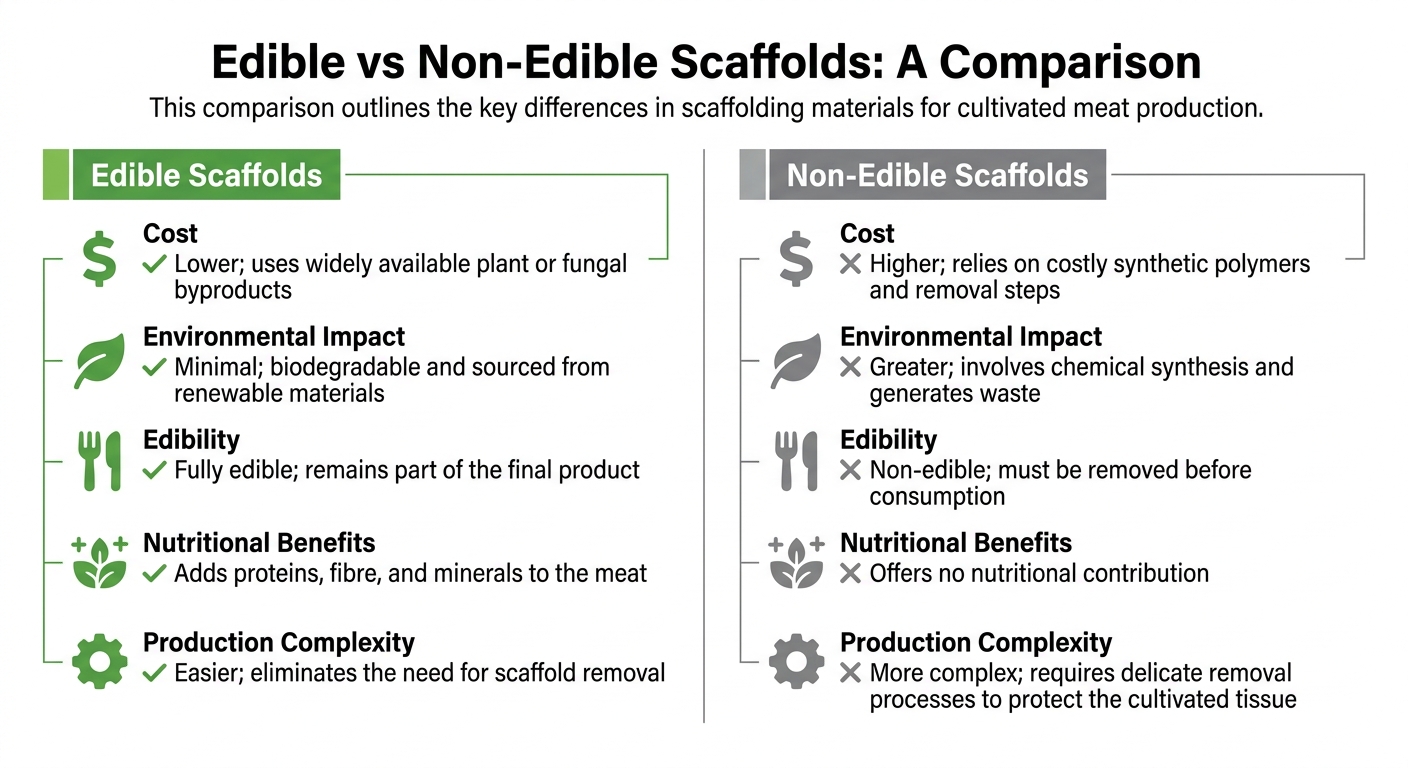
Edible and non-edible scaffolds differ in more than just their ability to be consumed. Here's how they compare:
| Factor | Edible Scaffolds | Non-Edible Scaffolds |
|---|---|---|
| Cost | Lower; uses widely available plant or fungal byproducts. | Higher; relies on costly synthetic polymers and removal steps. |
| Environmental Impact | Minimal; biodegradable and sourced from renewable materials. | Greater; involves chemical synthesis and generates waste. |
| Edibility | Fully edible; remains part of the final product. | Non-edible; must be removed before consumption. |
| Nutritional Benefits | Adds proteins, fibre, and minerals to the meat. | Offers no nutritional contribution. |
| Production Complexity | Easier; eliminates the need for scaffold removal. | More complex; requires delicate removal processes to protect the cultivated tissue. |
These comparisons highlight why edible scaffolds are becoming a preferred choice in cultivated meat production. They simplify processes, add nutritional value, and align with sustainable practices, making them a promising innovation in the field.
Challenges and Developments in Edible Scaffolding
Edible scaffolds face two main hurdles: achieving cost efficiency at scale and meeting expectations for texture and flavour.
Addressing Cost and Scalability
Cost is a significant obstacle to making cultivated meat a viable option for the masses. Early research relied on medical-grade polymers, which are far too expensive for large-scale food production. These materials could make cultivated meat prohibitively costly. However, edible scaffolds eliminate the need for costly removal processes, offering a more practical solution.
To tackle this, researchers are exploring affordable, food-safe materials like soy protein, chickpea protein, wheat gluten, and mycelium. These materials are readily available and cost-effective. Techno-economic models suggest that scaling production to a 262,000 L airlift reactor could lower the cost of goods sold to around £13/kg (about $17/kg), compared to £27/kg ($35/kg) for a smaller 42,000 L stirred-tank bioreactor[4]. This highlights how optimising bioreactor design and choosing the right materials can significantly reduce costs.
"Strategies to support the production of cultured meats at the scale required for food consumption will be critical." - Kawecki, N Stephanie, et al. [4]
While cost efficiency is vital, it’s equally important to ensure the final product delivers on texture and taste.
Improving Texture and Taste
Creating the right texture and flavour is another major challenge. Natural muscle tissue has a stiffness range of 2 to 12 kPa, which is critical for proper cell differentiation and achieving the desired softness in the final product[5]. However, inconsistencies in scaffold structure can lead to uneven textures, which may deter consumers.
Mycelium scaffolds offer a promising solution. In October 2022, researchers at the University of California, Davis, led by Minami Ogawa, used the fungus Aspergillus oryzae to develop 0.9 mm edible scaffold pellets. Their study showed nearly double the myoblast cell activity compared to conventional methods[4]. Mycelium’s fibrous structure not only supports cell growth but also enables the direct addition of flavours, fats, and nutrients[4].
Cultivated fish presents unique challenges due to its distinct texture. Scaffolds for fish need to mimic the "scaly" texture typical of fish, requiring myofibrillar proteins. Fish collagen, which has low thermal stability, loses its structure during cooking, adding to the complexity[5]. Polysaccharide-based scaffolds, such as alginate and cellulose, are scalable and safe but often fall short in nutritional value compared to protein-based options[5]. Balancing structure, nutrition, and sensory appeal remains a work in progress.
Addressing these challenges in texture and flavour is crucial for advancing edible scaffolding and unlocking further possibilities in cultivated meat production.
The Future of Edible Scaffolding in Cultivated Meat
Edible scaffolding is set to revolutionise how Cultivated Meat reaches consumers. By using affordable, food-safe materials like soy protein, wheat gluten, and mycelium, manufacturers can eliminate the need for expensive scaffold removal processes. This shift not only simplifies production but also significantly cuts costs. Combined with ongoing advancements in technology, this approach aligns perfectly with changing consumer expectations.
Around the world, regulatory bodies are increasingly approving Cultivated Meat. Key milestones in countries like Singapore, Israel, the UK, and the US highlight growing confidence in this technology and pave the way for broader consumer access.
"Consumer acceptance will therefore likely depend not only on the product quality but also on the industry's ability to scale-up production to a level where CM can compete directly with traditional meat in terms of availability and cost." - npj Science of Food [2]
New scaffold materials are now making it possible to produce whole cuts like steaks and loins. Materials such as decellularised plant tissues and fungal mycelium offer the three-dimensional structure needed to mimic the texture and appearance of traditional meat - both critical for winning over consumers. These innovations not only lower production costs but also improve the texture and nutritional quality of the final product.
As scaffolding technology continues to evolve and production scales up, Cultivated Meat is expected to achieve price parity with conventional meat. This milestone will likely accelerate its adoption in the UK, making high-quality Cultivated Meat an accessible and sustainable choice for consumers. For more updates on the latest in Cultivated Meat technology, visit Cultivated Meat Shop.
FAQs
Will edible scaffolds change how cultivated meat tastes?
Edible scaffolds can influence the flavour profile of cultivated meat by boosting its aromatic characteristics and allowing for customised flavours. This opens the door to creating distinctive taste experiences that align with individual consumer preferences.
Are edible scaffolds safe for people with allergies?
Edible scaffolds for cultivated meat are developed to adhere to strict safety regulations, ensuring they are food-safe and non-toxic. However, when it comes to allergies, the safety of these scaffolds depends on the materials they’re made from. Rigorous testing is conducted to confirm they’re safe to consume, but it’s always wise to review the specific ingredients or materials used, especially if you have known allergies.
When will scaffold-based whole cuts be available in the UK?
Scaffold-based whole cuts are projected to hit the UK market by around 2027. Currently, regulatory approvals are underway, and these products are expected to appear in supermarkets once the necessary processes are completed.


