

Cultivated meat could soon become affordable for everyday consumers. Scaling up bioreactors - moving from small lab setups to industrial systems holding tens of thousands of litres - has drastically reduced production costs compared to traditional methods. Current prices exceeding £10,000 per kilogram could drop to under £10 per kilogram with larger systems and optimised processes.
Key points:
- Larger bioreactors improve efficiency and reduce costs by spreading fixed expenses over higher production volumes.
- Food-grade bioreactors, costing £12,500, are replacing pharmaceutical-grade systems priced at £250,000.
- Advanced techniques like serum-free media and continuous production lower costs further, with some estimates reaching £1.95 per kilogram.
- Challenges include high upfront investment and achieving high cell densities (currently 5–10 g/L, with potential up to 360 g/L).
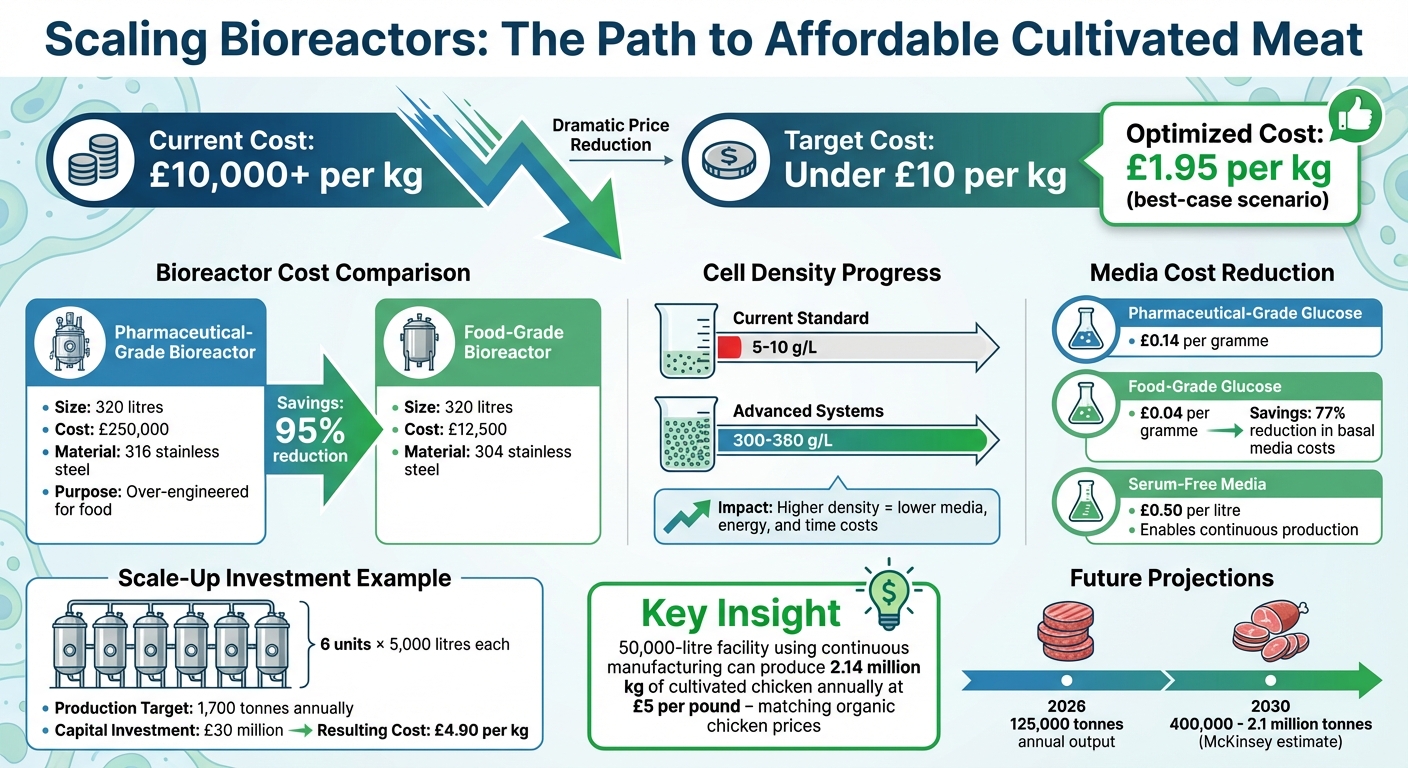
Cost Reduction Pathway for Cultivated Meat Production: From Lab to Commercial Scale
Dr. Marianne Ellis: Designing large-scale bioreactors and bioprocesses for cultivated meat
sbb-itb-c323ed3
The Challenges of Scaling Bioreactors
Scaling up bioreactors for cultivated meat production comes with its fair share of obstacles. While larger systems promise reduced costs per unit, both technical and financial challenges persist.
High Costs of Current Bioreactor Systems
At the moment, many cultivated meat companies depend on pharmaceutical-grade bioreactors. These systems, originally designed for drug manufacturing, are over-engineered for food production. A 320-litre pharmaceutical-grade bioreactor costs around £250,000, largely due to its advanced materials and sensors that go beyond the requirements for producing cultivated meat [5]. This makes them not only expensive but also ill-suited for the industry’s needs.
On the other hand, companies focusing on food-grade bioreactors have made strides in reducing costs. For instance, Meatly offers a 320-litre bioreactor for approximately £12,500, slashing costs by 95% compared to pharmaceutical systems [5]. However, many producers are still stuck with legacy systems that aren’t designed for cost-effective food production, highlighting the gap that remains to be bridged.
Problems with Cell Growth and Density
Another major challenge lies in achieving high cell density. Current bioreactors typically reach densities of just 5–10 grammes per litre, though some advanced setups manage to achieve 300–360 grammes per litre [2]. Lower densities translate to higher consumption of media, energy, and time - factors that drive up the cost of producing cultivated meat.
Compounding the issue are inefficiencies like inefficiencies in how nutrients reach cells, such as inadequate oxygen transfer, rapid depletion of media, and slow cell doubling times. Addressing these inefficiencies could lead to dramatic cost reductions. One industry study estimated that optimising these factors might lower production costs from about £350,000 to £1.6 per kilogramme [2]. However, until these technical challenges are resolved, scaling production remains a costly endeavour.
Capital Requirements for Scale-Up
Scaling to larger systems also demands significant upfront investment. Facilities capable of handling 5,000- to 50,000-litre bioreactors require substantial capital. For instance, a plant designed to produce 1,700 tonnes annually might need six 5,000-litre units, with an estimated capital expenditure of just under £30 million [6]. While such a setup could potentially bring the cost of cultivated chicken down to £4.90 per kilogramme [4], the initial financial commitment is a major hurdle for most companies.
Currently, many producers operate on a kilogramme scale and aim to transition to tonne-scale production within the next three years [1][3]. However, achieving this leap will require overcoming both the technical and financial barriers outlined above.
New Developments in Bioreactor Design
As scaling challenges in the cultivated meat industry persist, recent advancements in bioreactor design are offering practical solutions. These innovations aim to lower equipment costs, improve cell culture processes, and encourage collaboration across the sector.
Affordable Bioreactor Models
New food-grade bioreactor models now incorporate 304 stainless steel instead of the more expensive 316-grade steel, alongside simplified sensor arrays [8]. This adjustment significantly reduces costs while maintaining essential food safety standards. By moving away from outdated and costly legacy systems, these models are better suited to the needs of modern production.
Improved Media and Processes
Cell culture media, which accounts for over half of variable production costs [9], has seen notable cost reductions. In August 2024, Professor Yaakov Nahmias from the Hebrew University of Jerusalem, in collaboration with Believer Meats, published a study in Nature Food. They demonstrated a continuous manufacturing process using tangential flow filtration (TFF) that ran for 20 days, achieving a biomass expansion of 130 billion cells per litre. This process used a serum-free medium priced at just £0.50 per litre. The study estimated that a 50,000-litre facility could produce 2.14 million kilogrammes of cultivated chicken annually at a cost of approximately £5 per pound, matching the price of organic chicken [7].
In another 2023 breakthrough, Mosa Meat partnered with Nutreco to replace 99.2% of their basal cell feed by weight with food-grade components. This shift maintained cell growth rates comparable to those achieved with pharmaceutical-grade media while significantly cutting costs. Transitioning from pharmaceutical-grade to food-grade ingredients has the potential to reduce basal media expenses by around 77% [9]. For instance, food-grade glucose costs approximately £0.04 per gramme, compared to £0.14 per gramme for reagent-grade glucose [9]. These advancements in media and processes align with the cost savings achieved through the latest bioreactor designs.
"The study confirms early theoretical calculations that serum-free media can be produced at costs well below $1/L without forfeiting productivity, which is a key factor for cultivated meat achieving cost-competitiveness."
- Dr. Elliot Swartz, Principal Scientist at Cultivated Meat, The Good Food Institute [7]
Collaboration and Open-Source Progress
Collaboration within the industry is driving these advancements forward. Transparency and open data sharing are helping to accelerate progress. Open-source techno-economic models and real-world data are validating the economic viability of cultivated meat, allowing smaller companies to benefit from shared insights [7]. This spirit of collaboration is also evident in media formulation research, as companies work alongside suppliers to create cost-effective, standardised serum-free media options [8].
"GFI applauds the spirit of openness that continues to characterize cultivated meat researchers like Dr. Nahmias and his colleagues, who understand that showing the scientific potential of cultivated meat will benefit all scientists working in the field."
- Bruce Friedrich, President, The Good Food Institute [7]
Pathways to Affordable Cultivated Meat
Combined Solutions for Cost Reduction
Achieving cost parity with traditional meat relies on combining food-grade bioreactors, optimised media, and continuous production methods.
One effective way to cut equipment costs is by transitioning from pharmaceutical-grade 316 stainless steel to the more affordable food-grade 304 stainless steel for bioreactors. Additionally, shifting from batch to continuous processing can significantly increase productivity while lowering expenses [8].
Media optimisation plays a key role, as it represents over half of the variable production costs. To address this, the industry is moving away from costly recombinant proteins and turning to plant-based hydrolysates derived from sources like soy, rapeseed, or yeast, which provide nutrients at a lower cost. Companies are also adopting advanced filtration techniques to recycle media, reducing both waste and expenses [8][9][3].
By integrating these strategies, production costs can be reduced to competitive levels. These approaches not only make cultivated meat more affordable but also lay the groundwork for even more favourable pricing in the future.
Future Pricing Projections
Building on these cost-saving measures, the industry is poised for further price reductions as production scales up. By 2026, annual output is projected to reach approximately 125,000 tonnes, with McKinsey estimating production volumes could range between 400,000 and 2.1 million tonnes by 2030 [8].
As more facilities adopt 50,000-litre bioreactor systems and continuous manufacturing processes, economies of scale are expected to lower prices even further [7]. Current production yields vary from 5–10 g/L to as much as 300–360 g/L. Advances in media formulations, supported by AI-driven optimisation and genome-scale metabolic models, are likely to accelerate these cost reductions [8].
"Overall, we advise suppliers, companies, and academic labs to collaborate on creating affordable serum-free media options and fit-for-purpose equipment, aiming to streamline efforts, enhance efficiency, and promote sustainable growth." - The Good Food Institute [8]
The journey to affordability doesn’t hinge on a single solution. Instead, it’s about integrating multiple strategies across the production process. As these innovations progress, cultivated meat is on track to become a commercially viable and accessible alternative in the UK market.
Conclusion: Bioreactor Scaling and the Future of Cultivated Meat
Scaling up bioreactors has become a critical focus in making cultivated meat production more affordable. The industry has made impressive strides, with production costs dropping significantly as operations transition from small-scale laboratories to commercial-scale systems.
Lab-scale setups are rapidly being replaced by various large-scale bioreactor designs. Companies are now implementing high-capacity bioreactor systems, moving from producing in kilogrammes to achieving tonne-scale annual outputs. These advancements, paired with purpose-built food-grade designs, show that cost-efficient infrastructure is becoming a reality.
Collaboration and innovation are driving this progress. Industry efforts to refine media formulations and improve equipment design are helping to lower costs even further. Success depends on combining breakthroughs across cell lines, media, and bioreactor efficiency. With yields varying between 5–10 g/L and 300–360 g/L based on bioprocess design, and promising results from continuous manufacturing methods, the industry is on track to compete with traditional meat in terms of price. These integrated advancements are paving the way for affordable cultivated meat.
As production scales up and technologies evolve, cultivated meat is becoming a viable and accessible option for consumers in the UK. To stay updated on how these developments are shaping the future of food, continue following Cultivated Meat Shop - your go-to resource for insights into this growing industry.
FAQs
Why do bigger bioreactors make cultivated meat cheaper?
Larger bioreactors play a key role in bringing down the cost of cultivated meat. By increasing production capacity and improving resource efficiency, they allow for higher output while reducing the cost per kilogram of meat. This advancement paves the way for cultivated meat to become more affordable and accessible in the coming years.
What’s stopping 50,000-litre bioreactors from being widely used now?
Ensuring even distribution of nutrients and oxygen, controlling shear stress, and achieving efficient mixing are major hurdles in large-scale systems. These technical difficulties not only drive up production costs but also heighten the risk of cell damage, making large-scale bioreactors challenging to implement effectively for now.
How soon could Cultivated Meat reach supermarket-level prices in the UK?
Cultivated meat could hit supermarket shelves in the UK at competitive prices by the late 2020s. Estimates indicate it might match the cost of conventional meat by around 2027. This shift hinges on progress in scaling up bioreactors and cutting production expenses, paving the way for cultivated meat to become a more accessible option for everyday shoppers.


