

Cultivated meat - real animal meat grown from cells - has sparked debate worldwide. While it offers a slaughter-free alternative to traditional farming, some countries have banned or restricted it due to concerns over farming jobs, food safety, and cultural traditions. Italy banned it entirely in 2023, and several U.S. states followed with restrictions. Critics argue these bans hinder efforts to reduce greenhouse gas emissions from livestock farming, which accounts for 11–19% of global emissions. However, sceptics cite regulatory gaps, economic risks for farmers, and resistance to lab-grown food as key reasons for opposition. This article breaks down why these bans exist and how they differ across regions.
Lab-grown meat: Why are countries banning it? - The Global Story podcast, BBC World Service

sbb-itb-c323ed3
Why Some Countries Restrict Cultivated Meat
The resistance to Cultivated Meat comes down to a mix of economic, regulatory, and cultural factors. These concerns shed light on why certain governments have acted swiftly to challenge a product that hasn’t yet gained widespread availability.
Protecting Livestock Industries and Rural Economies
Traditional livestock farming is deeply tied to local economies, particularly in rural areas. Governments are concerned that a pivot to Cultivated Meat could upend entire supply chains, impacting feed suppliers, slaughterhouses, processing facilities, and transportation networks reliant on conventional farming methods [6].
Another worry is the concentration of control over meat production. Cultivated Meat requires advanced bioreactors, expertise in cell biology, and substantial financial resources. Critics argue this could hand significant power to large corporations, leaving independent farmers - who currently produce much of the world’s meat - at a disadvantage [6][2].
In Italy, the agricultural association Coldiretti, representing over 1.6 million farmers and businesses, played a key role in passing Law 172/2023. This legislation became the first to completely ban both the production and sale of Cultivated Meat. Violations carry severe penalties, including fines of up to €150,000 and potential facility closures [5].
"Italy has led the way... preventing the spread of synthetic food through national legislation." - Ettore Prandini, President of Coldiretti [2]
Economic concerns, however, are only part of the picture. Regulatory uncertainty adds another layer of complexity.
Food Safety Concerns and Gaps in Regulation
Even for those who are not ideologically opposed to Cultivated Meat, the lack of long-term safety data raises red flags. As a relatively new technology, it falls under the precautionary principle in many countries, which delays its adoption until more is understood [6][5].
Some critics claim that the production of Cultivated Meat resembles pharmaceutical manufacturing more than traditional food production. This raises questions about whether current food safety standards are equipped to evaluate it properly [2]. Additionally, there’s debate over whether Cultivated Meat offers the same nutritional benefits as conventional meat. For instance, products grown predominantly from fibroblasts rather than muscle cells may lack a comparable protein profile [8].
In the EU, Cultivated Meat is classified as a Novel Food. This means it must pass a comprehensive safety review by the European Food Safety Authority (EFSA) before it can be sold [6][5].
"The risks [of cellular meat] are clearly closer to the pharmaceutical world than food products." - Representative for Farm Europe [2]
National Food Identity and Public Scepticism
Beyond economics and regulations, cultural factors play a significant role. In countries like Italy, France, and Spain, food is a cornerstone of national identity. The idea of producing steak in a lab rather than raising it on a farm clashes with longstanding culinary traditions and values [6].
Political narratives also contribute to public resistance. Right-leaning governments often frame Cultivated Meat as an imposition by disconnected elites, a message that resonates particularly in rural areas. Psychological studies suggest that food neophobia (fear of unfamiliar foods) and conspiracy-driven thinking are strong predictors of rejection of Cultivated Meat [3].
In April 2026, the EU introduced a ban preventing Cultivated Meat producers from using familiar animal names like "duck", "tenderloin", or "bacon" on their products. This move drew criticism from companies like Aleph Farms, which argued that such restrictions were premature and misplaced [7].
"Cultivated meat doesn't yet commercially exist in Europe and regulating its language before its framework is fully developed suggests the industry was caught in the crossfire of a different debate." - Didier Toubia, CEO, Aleph Farms [7]
How Bans and Restrictions Differ Across Countries
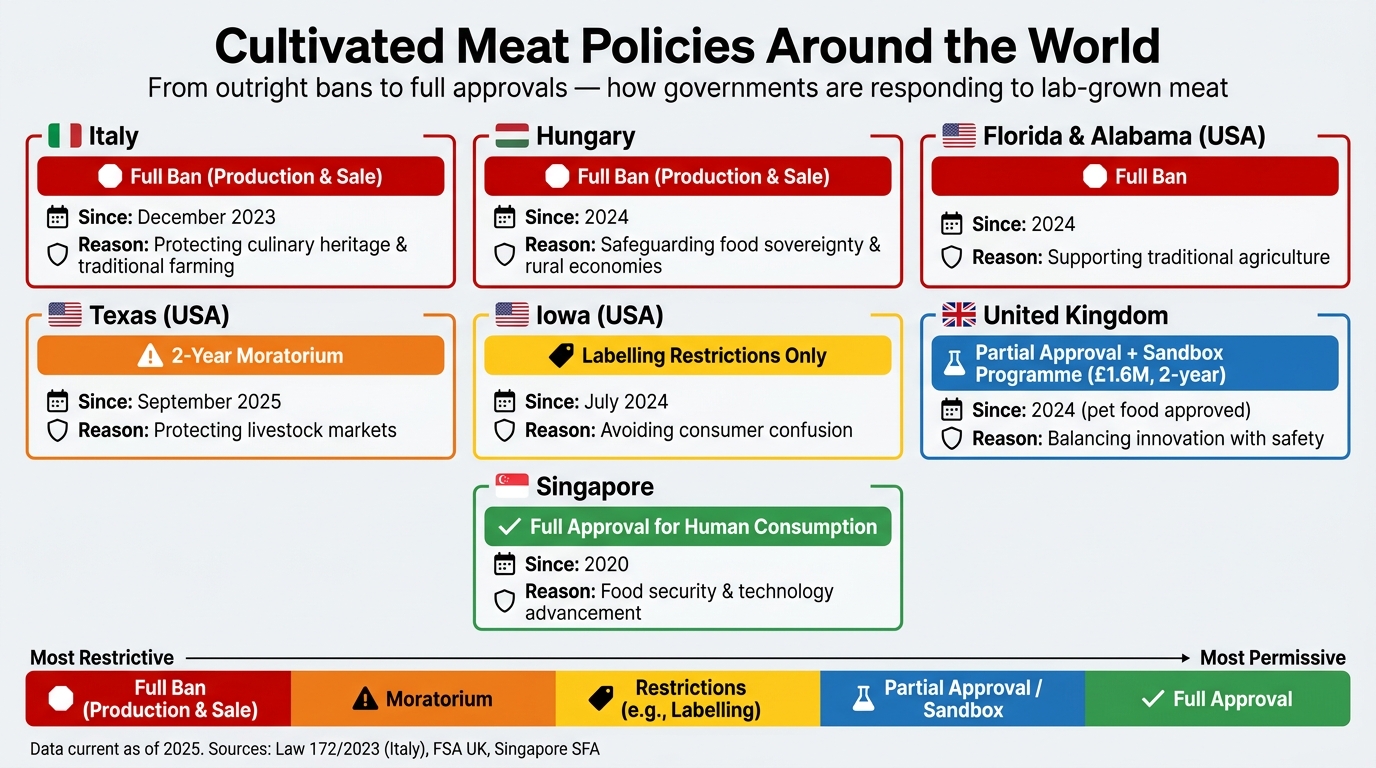
Cultivated Meat Policies by Country: Bans, Approvals & Restrictions
Governments around the world have taken vastly different approaches to Cultivated Meat, creating a patchwork of policies that range from outright bans to specific labelling rules. Here's a closer look at how these policies vary by country.
Types of Bans and Restrictions
Some countries have taken a hard stance. Italy and Hungary, for example, have implemented full bans on Cultivated Meat. This includes restrictions on production, sale, and marketing. Italy's Law 172/2023, passed in December 2023, marked a global first in this regard [9].
In the United States, the situation is more fragmented. While federal approvals exist, several states have introduced their own restrictions. Florida and Alabama enacted full bans in 2024, while Texas implemented a two-year moratorium starting 1 September 2025. This moratorium has already sparked legal challenges from industry stakeholders [4].
"The purpose of these bans is to try to kill the cultivated-meat industry before it gets off the ground." - Myra Pasek, General Counsel, Upside Foods [4]
Other states, like Iowa, have focused on labelling requirements. From July 2024, products must carry terms like "fake", "imitation", or "meatless" [11]. Meanwhile, the United Kingdom has taken a more experimental approach, approving Cultivated Meat for pet food in July 2024 and launching a £1.6 million, two-year sandbox programme for human consumption [10]. Singapore, on the other hand, has been a pioneer, granting full approvals for human consumption as early as 2020 [11].
These varied policies highlight the tension between preserving traditional food systems and embracing new food technologies.
How Policy Rationale and Impact Compare
The reasoning behind these policies often reflects broader cultural and economic priorities, which, in turn, shape their outcomes. Full bans tend to focus on protecting culinary traditions, traditional farming, and food sovereignty. Labelling rules are designed to minimise consumer confusion, while sandbox initiatives aim to strike a balance between safety and innovation.
The table below provides a comparative look at how different countries approach Cultivated Meat policies:
| Country/Region | Policy Type | Effective Date | Primary Rationale |
|---|---|---|---|
| Italy | Full Ban (Production & Sale) | December 2023 | Protecting culinary heritage and traditional farming [9] |
| Hungary | Full Ban (Production & Sale) | 2024 | Safeguarding food sovereignty and rural economies [9] |
| Florida/Alabama | Full Ban | 2024 | Supporting traditional agriculture [11] |
| Texas | 2-Year Moratorium | September 2025 | Protecting livestock markets [4] |
| Iowa | Labelling Restrictions | July 2024 | Avoiding consumer confusion [11] |
| United Kingdom | Partial Approval + Sandbox | 2024 (pet food) | Balancing innovation with safety [10] |
| Singapore | Full Approval | 2020 | Addressing food security and advancing technology [11] |
The political context plays a key role in shaping these policies. Countries like Singapore and Israel, which have pressing food security concerns, have moved quickly to approve Cultivated Meat. In contrast, European nations with strong agricultural lobbies and deep-rooted food traditions have leaned towards stricter regulations. The United Kingdom, navigating its post-Brexit identity, appears to be treading a middle path - prioritising public trust while keeping an eye on global competitiveness in this emerging industry.
How These Challenges Can Be Addressed
Tackling these challenges requires a mix of practical solutions that focus on regulation, support for farmers, and better communication with the public. By addressing the core issues of regulatory uncertainty, economic concerns, and public mistrust, progress can be made towards overcoming the barriers to acceptance and implementation.
Building Clear, Science-Based Regulations
Establishing transparent, science-driven regulations is a key step in building public trust. In 2024, the Food Standards Agency (FSA) and Food Standards Scotland launched a £1.6 million, two-year sandbox programme. This initiative aims to work directly with Cultivated Meat startups, providing safety insights and helping businesses navigate regulatory requirements [10]. Instead of reacting to products after they hit the market, this proactive collaboration allows regulators and companies to define clear rules together.
"Early, clear, transparent and proactive communications from regulatory agencies is important to explain safety criteria and to tackle mis/disinformation." - Food Standards Agency [3]
Independent safety assessments, aligned with international frameworks like the Codex Alimentarius, add another layer of credibility [12]. These efforts not only address safety concerns but also help rural communities adapt to market transitions.
Helping Livestock Farmers Adapt
Economic challenges must also be addressed to ease the transition for traditional farmers. Governments can conduct socio-economic impact assessments and create targeted support schemes to evaluate employment and land-use changes [2][12]. Encouraging open dialogue between the Cultivated Meat industry and livestock farmers is vital. When these groups are isolated or seen as opponents, it often leads to resistance and calls for bans rather than cooperation [12]. Policymakers should also ensure that funding for alternative proteins doesn’t come at the expense of regenerative and sustainable farming initiatives [3]. These measures can alleviate economic fears and foster collaboration rather than division.
Improving Public Awareness and Labelling
Public scepticism often arises from a lack of understanding rather than outright opposition. While scientific evidence is important, increasing everyday exposure to Cultivated Meat is essential for building acceptance [3].
Honest and clear labelling is critical. Linus Pardoe, Senior UK Policy Manager at the Good Food Institute Europe, emphasised:
"In food law, you cannot mislead consumers... To not be clear on the origin of production within these products will probably be falling close to misleading consumers." [10]
Transparent labels help build trust and reduce the risk of bans driven by misinformation. Standardising terms like "Cultivated Meat" is a simple yet effective way for regulators and producers to promote clarity [8][10]. Resources like the Cultivated Meat Shop’s plain-language guides also play a role in demystifying the production process and fostering consumer confidence.
What the Future Holds for Cultivated Meat Policy
The regulatory environment for Cultivated Meat is moving from theoretical discussions to concrete oversight, as governments worldwide begin applying established food safety standards. However, the speed of progress varies significantly across regions.
One of the most promising developments is the expectation of international regulatory reciprocity. As nations grow more confident in managing their domestic frameworks, they are likely to start recognising one another's safety evaluations. This could simplify processes for producers, cutting down on duplication and making it easier to enter new markets.
"Historically, we've seen reciprocity develop once countries are comfortable managing technologies domestically. I would expect that to happen here too, eventually." - Suzi Gerber, Executive Director, Association for Meat, Poultry and Seafood Innovation [1]
This potential for reciprocity highlights the contrasting regulatory strategies being adopted in different parts of the world. For example, in the United States, five Cultivated Meat products successfully passed the combined FDA–USDA framework between 2022 and 2025 [1][13]. Singapore has also approved three distinct products, while the European Union lags behind, with no approvals yet. Pressure is mounting on the European Commission to streamline its regulatory processes.
"The Commission is well aware that regulation needs to be streamlined. Otherwise, innovation may go outside Europe." - Lorena Savani, Director of Biotech, EIT Food [14]
The gap between regions fostering innovation and those imposing stricter restrictions is expected to grow. Countries like Italy and Hungary have adopted tough measures, while the UK has struck a more balanced approach. Through its Food Standards Agency sandbox, which will run until February 2027, the UK aims to navigate the middle ground. Interestingly, research indicates that as people become more familiar with Cultivated Meat, their willingness to try it increases [3]. This suggests that rising public awareness could gradually reduce political opposition, potentially leading to regulatory shifts that align safety standards with market growth.
In this evolving landscape, Cultivated Meat Shop plays a role by educating consumers ahead of the products' arrival in supermarkets. This early engagement could help pave the way for broader acceptance and smoother policy transitions.
FAQs
Is Cultivated Meat safe to eat?
Cultivated meat is designed to be safe to eat, although it’s not currently available for purchase in the UK. Before hitting the shelves, it must undergo a thorough safety review by the Food Standards Agency. Once approved, it will comply with the same strict food safety rules as other food products. For more information on these safety standards, Cultivated Meat Shop provides helpful resources.
Why are some governments banning Cultivated Meat before it’s widely sold?
Some governments have chosen to restrict cultivated meat, aiming to safeguard traditional farming practices, rural livelihoods, and national food heritage from what they see as potential competition. These bans are often influenced by lobbying from agricultural groups, worries about labelling and safety standards, or a broader reluctance to shift established food systems. The goal behind such policies is often to delay the introduction of cultivated meat until the industry matures and proves its commercial viability.
Could Cultivated Meat bans be challenged or reversed?
Legal challenges to bans on cultivated meat are not only possible but are already happening in some regions. Experts in the field argue that these bans often lack a solid scientific foundation and could even violate trade laws at both regional and international levels. For example, in the United States, certain companies have taken legal action against state-level restrictions. Similarly, bans within the European Union are being questioned for potentially clashing with internal market regulations and individual dietary rights.
For updates on these legal developments, visit Cultivated Meat Shop.


