

Cultivated pet food is a new option for feeding pets with meat grown directly from animal cells, offering a resource-efficient and eco-conscious alternative to conventional meat. Here's what you need to know:
- Availability: Currently limited in the UK, with products like Meatly's "Chick Bites" available at Pets at Home in Brentford since February 2025.
- Online Options: Platforms like Cultivated Meat Shop and brands such as The Pack and Omni are expected to expand availability soon. Sign up for updates to stay informed.
- Challenges: High production costs and limited infrastructure mean widespread access may take 3–5 years.
- Pricing: Products like "Chick Bites" are priced at £3.49 for a 50g pack, with hybrid options being more affordable.
- Health Benefits: Free from antibiotics and contaminants, cultivated pet food provides high-quality nutrients for pets.
If you're keen to try cultivated pet food, start by visiting Pets at Home in Brentford or signing up for notifications from online retailers and brands. Wider availability is expected by 2026–27.
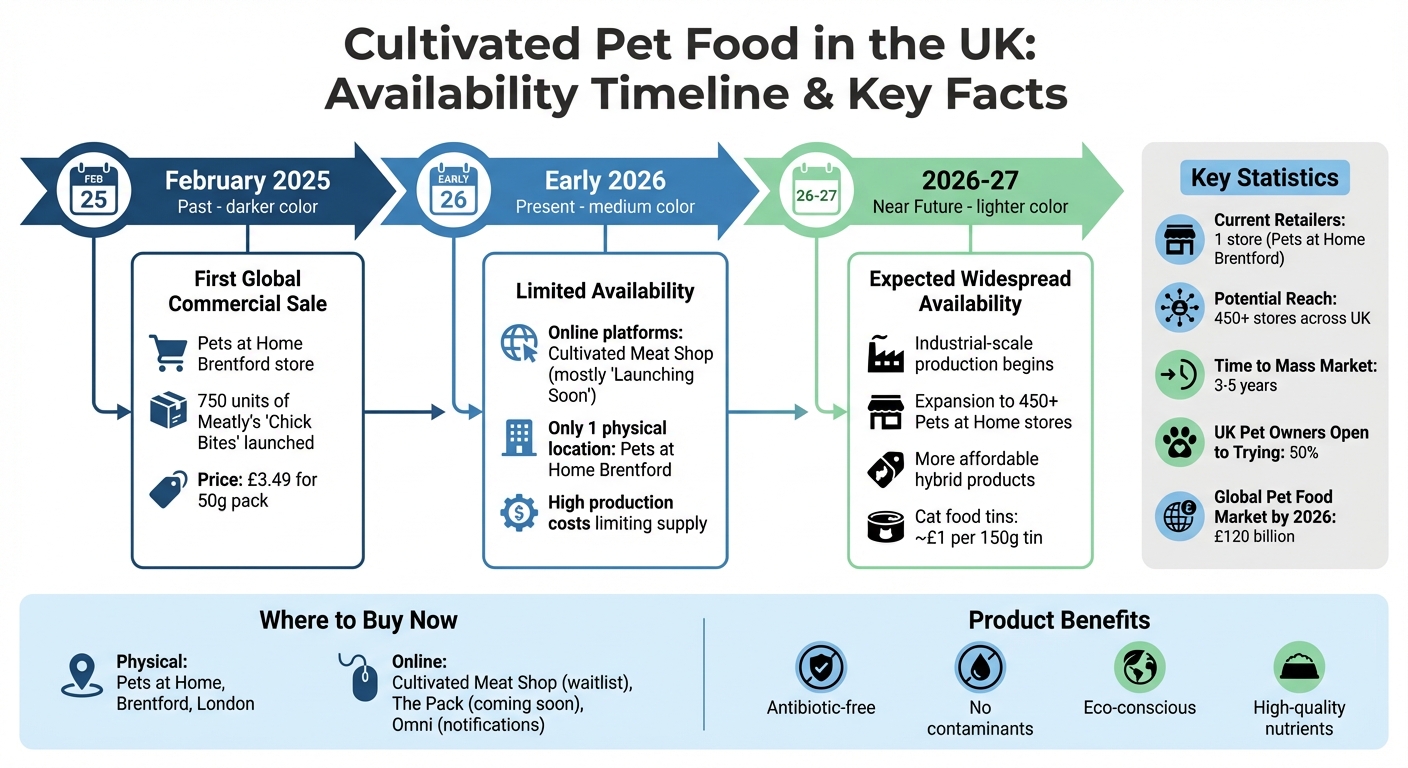
UK Cultivated Pet Food Availability Timeline 2025-2027
Meatly Launches Pet Food in the UK
sbb-itb-c323ed3
Where to Buy Cultivated Pet Food in the UK
As of early 2026, cultivated pet food is still a rarity in the UK. The market remains in its testing phase, with only a few products making their way to consumers. Knowing where to search and staying updated can help you access these innovative products as they become more widely available.
Online Platforms
Finding cultivated pet food online is currently a challenge, as most platforms focus on registrations rather than immediate purchases. Cultivated Meat Shop has dedicated sections for dog food, cat food, and treats, but these are often marked as "Unavailable" or "Launching soon" due to limited production runs [1]. Signing up for notifications is a good way to stay informed about new stock.
Another key player to watch is The Pack, a plant-based pet food brand collaborating with Meatly to produce Chick Bites. As production ramps up, The Pack is expected to play a significant role in online distribution [8][9]. Additionally, Pets at Home, a major investor in this technology, offers online ordering and is poised to make cultivated pet food more accessible digitally [9]. Owen Ensor, Founding CEO of Meatly, has expressed optimism about scaling production:
Next we'll scale our production and make products more widely available to consumers [9].
While online platforms are a great way to register interest and receive updates, some physical stores are already offering these products directly.
Physical Retailers
Currently, Pets at Home is the only physical retailer in the UK stocking cultivated pet food. In February 2025, its Brentford store in London became the first location globally to sell cultivated pet food to the public [8][10]. The launch featured a limited release of Chick Bites. Anja Madsen, Chief Operating Officer at Pets at Home, highlighted the potential of this innovation:
This innovation has the potential to significantly reduce the environmental impact of pet food by leveraging environmental benefits of cultivated meat and will be a game-changer for the industry [4].
Although the Brentford store remains the main test site, Pets at Home operates over 450 stores across the UK. As production capacity grows, the availability of cultivated pet food is expected to expand gradually over the next three to five years [8].
Understanding Availability and Stock Limitations
Why Availability is Limited
Cultivated pet food is still hard to come by, largely because the industry is in its infancy. The first commercial sale only happened in February 2025, when Pets at Home's Brentford store introduced just 750 units of Chick Bites dog treats[8]. This small-scale launch underscores the hurdles manufacturers face when transitioning from lab prototypes to full-scale production.
One of the biggest obstacles is the high cost of production. Essential components like growth factors and cell culture media for producing cultivated meat are significantly more expensive than traditional meat inputs[1]. Owen Ensor, CEO of Meatly, explained the situation:
Currently it is expensive but we've made great strides bringing down the cost dramatically over the last two years and are going to continue to do so. [11]
In addition to raw material costs, scaling up production requires massive investments in infrastructure, such as fermenters and various bioreactor designs. For UK-based startups like Meatly, funding has been a challenge - they’ve secured only about 1% of the total European investment in cultivated meat. Experts predict it could take another three to five years before cultivated pet food becomes widely accessible to UK consumers[8].
How to Find Products in Your Area
Given these production challenges, finding cultivated pet food requires some effort. Start by checking Pets at Home's Brentford store, which was the first physical outlet to stock these products. It’s also worth contacting other local Pets at Home branches, as the chain operates over 450 stores across the UK, and availability may vary.
For online shoppers, the Cultivated Meat Shop offers a dedicated section for dog food, cat food, and treats. However, many items are currently listed as "Unavailable" or "Launching soon." Signing up for notifications on the site can keep you informed about new stock or product launches in your area.
Keep an eye on collaborations between cultivated meat producers and established pet food brands. For instance, Meatly partnered with The Pack to create Chick Bites and worked with Omni on cultivated chicken cat food[8][12]. Subscribing to brand newsletters or following their social media accounts can help you stay updated on future releases.
Staying Updated on Future Product Launches
Joining Waitlists and Early Access Programmes
Getting early access to cultivated pet food is as simple as joining waitlists or early access programmes. The Cultivated Meat Shop has a handy "Register your interest" feature, which lets you sign up for updates on upcoming product launches. Whether you're looking for dog treats, cat food, or dog food, this platform acts as a one-stop shop for UK pet owners eager to stay in the loop.
You can also sign up for manufacturer waitlists, like Meatly's newsletter, to hear about new product announcements. Omni, known for its cultivated chicken cat food developed in partnership with Meatly, offers notifications when products become available. With Meatly's CEO Owen Ensor stating, "Next we'll scale our production and make products more widely available to consumers" [2], these direct updates are invaluable during the anticipated 3-to-5-year production scaling phase. Combining retailer and manufacturer updates ensures you won't miss out.
For exclusive launches, Pets at Home is a key player. As both an investor and launch partner for various cultivated pet products, following their corporate updates or signing up for their loyalty programme can give you a head start on limited releases.
Following Retailer and Manufacturer Announcements
While waitlists are a great start, keeping an eye on announcements from retailers and manufacturers ensures you're always ahead of the game. Take THE PACK, for example. Known for its plant-based offerings, THE PACK already has over 200 regular direct-to-consumer customers and has teamed up with Meatly for Chick Bites. Subscribing to their updates is a smart way to learn when cultivated pet food hits the market.
Regulatory updates also provide valuable clues. The UK's Department for Environment, Food and Rural Affairs (Defra) typically approves products about three months before they become available to consumers. Keeping tabs on trade publications like Pet Food Processing and vegconomist can help you spot these milestones. With industry leaders focused on making cultivated pet food more accessible, these official channels are essential for tracking major developments.
Preparing for Wider Availability
Product Formats and Pricing
The initial rollout of cultivated pet food will focus on wet food and treats. First on the shelves will be 150g tins of chicken pâté for cats, priced at around £1 per tin [12]. This positions the product alongside premium-grade conventional options in terms of cost.
For a more budget-friendly alternative, hybrid products combine cultivated chicken with ingredients like plant-based, yeast, or algae proteins. These blends retain the authentic taste of meat while keeping prices more affordable [2][12]. As production ramps up, costs are expected to decrease further. Meatly, for example, has already managed to reduce the cost of its cultivation media to under £1 per litre [6].
"We are proving that there is a safe and low-capital way to rapidly bring cultivated meat to market." – Owen Ensor, CEO, Meatly [6]
Keep an eye out for labels like "serum-free" or "protein-free", which indicate the use of newer cultivation technologies aimed at maintaining competitive pricing over time [6]. With the global pet food market projected to hit £120 billion by 2026 [12], affordability is a key focus for manufacturers aiming to appeal to everyday pet owners.
While pricing and formats are becoming clearer, it’s equally important to assess whether these products meet your pet's specific nutritional needs.
Evaluating Products for Your Pet
Choosing the right product involves more than just price - it’s about ensuring quality and suitability for your furry friend. Look for products that have secured UK regulatory approval. Items cleared by the Food Standards Agency, the Department for Environment, Food and Rural Affairs, and the Animal and Plant Health Agency have undergone extensive safety testing [6][7]. For example, Meatly’s offerings are guaranteed to be free from GMOs, antibiotics, harmful pathogens, and heavy metals [6].
Nutritionally, cultivated meat mirrors traditional meat, offering essential amino acids, fatty acids, and vitamins [2]. Cats, in particular, require nutrients like taurine, which are harder to source from plant-based proteins [5][12]. Dr. Guy Sandelowsky, Co-founder of Omni, highlights the benefits:
"This means more essential vitamins, minerals and omegas, and an elimination of the troublesome components that can be found in traditional meat, such as antibiotic residues" [5].
Transparency is also crucial. Brands should clearly state how much cultivated meat is used compared to any plant-based fillers. If your pet has a sensitive stomach, consider introducing cultivated proteins gradually through treats before transitioning to full meals. Look for products labelled as "complete" to ensure they meet your pet’s nutritional requirements for their specific life stage. With half of UK pet owners open to feeding their pets cultivated meat [3], brands are focusing on creating options that balance ethical considerations with top-notch nutrition.
Conclusion
The UK has taken the lead in Europe with the introduction of cultivated pet food, starting with limited-edition items like Meatly's 'Chick Bites', available at Pets at Home in Brentford. While these products are currently part of exclusive launches and trial phases, experts predict that large-scale production could become a reality by 2026–27. As Owen Ensor, CEO of Meatly, explained:
Truly industrial production volumes are expected around 2026-27 [13].
If you're eager to stay ahead, consider registering on the Cultivated Meat Shop for early access and updates. Keep an eye on major retailers like Pets at Home and follow brands such as THE PACK and Omni for announcements about upcoming hybrid products.
As production ramps up and costs come down, cultivated pet food is poised to shift from a niche concept into a practical option for everyday feeding. This development not only offers a solution to environmental challenges (and overcoming production hurdles) but also meets the nutritional needs of pets in a forward-thinking way. While availability is still limited, these early steps mark the beginning of a new era in pet nutrition.
The future of feeding your furry friends has already begun.
FAQs
What makes cultivated pet food environmentally friendly?
Cultivated pet food offers a far greener alternative to traditional meat-based options. For instance, producing cultivated meat results in just 8% of the CO₂ emissions per kilogram compared to beef. It also slashes land use by up to 90%, significantly cutting down on air pollution.
What’s more, this approach demands far fewer resources like water and energy, helping to curb deforestation, prevent waterway pollution, and protect biodiversity. By growing meat directly from animal cells, it sidesteps the inefficiencies of raising livestock, making it a smart, eco-conscious option for pet owners who care about the planet.
How can I find out when cultivated pet food becomes available near me?
To stay updated on the availability of cultivated pet food in the UK, here are a few easy ways to stay in the loop:
- Subscribe to updates from Cultivated Meat Shop: Be among the first to hear about new product launches, restocks, and upcoming releases. Joining their waitlist ensures you’ll get timely alerts when cultivated pet food hits the shelves.
- Check major retailers like Pets at Home: This retailer has previously introduced cultivated pet treats and is likely to stock future products. Visit their website or sign up for their newsletter to stay informed.
- Follow industry news: Specialist outlets and newsletters often cover new product approvals and launches in the UK. Keeping up with these sources can help you stay ahead of the latest developments.
By keeping an eye on these channels, you’ll be ready to grab cultivated pet food as soon as it’s available near you.
How can I safely introduce cultivated pet food to my pet’s diet?
When introducing cultivated pet food into your pet’s diet, take it slow - just like you would with any new food. Look for products labelled as complete and balanced feed that meet UK safety standards. This ensures the food is free from harmful contaminants, GMOs, antibiotics, and pathogens. Such standards guarantee that the food provides your pet with all the essential amino acids, vitamins, and minerals they need, just like traditional meat.
Start with small portions and keep an eye on your pet’s weight, stool consistency, and overall health. If you notice anything unusual, consult your vet before increasing the amount. It’s worth noting that cultivated pet food is considered a premium product, so it may come with a higher price tag. For instance, a 50 g pack of cultivated chicken treats is currently priced at £3.49 in the UK. Since availability is still limited, signing up for updates on platforms like Cultivated Meat Shop can help you stay in the loop about new products and launches.


